How much does a European Christmas markets trip cost in 2026?
What five nights across Prague and Vienna really costs per person in 2026: hotels, trains, Gluhwein, the mug deposit nobody mentions, and how to split a two-currency trip without a spreadsheet.
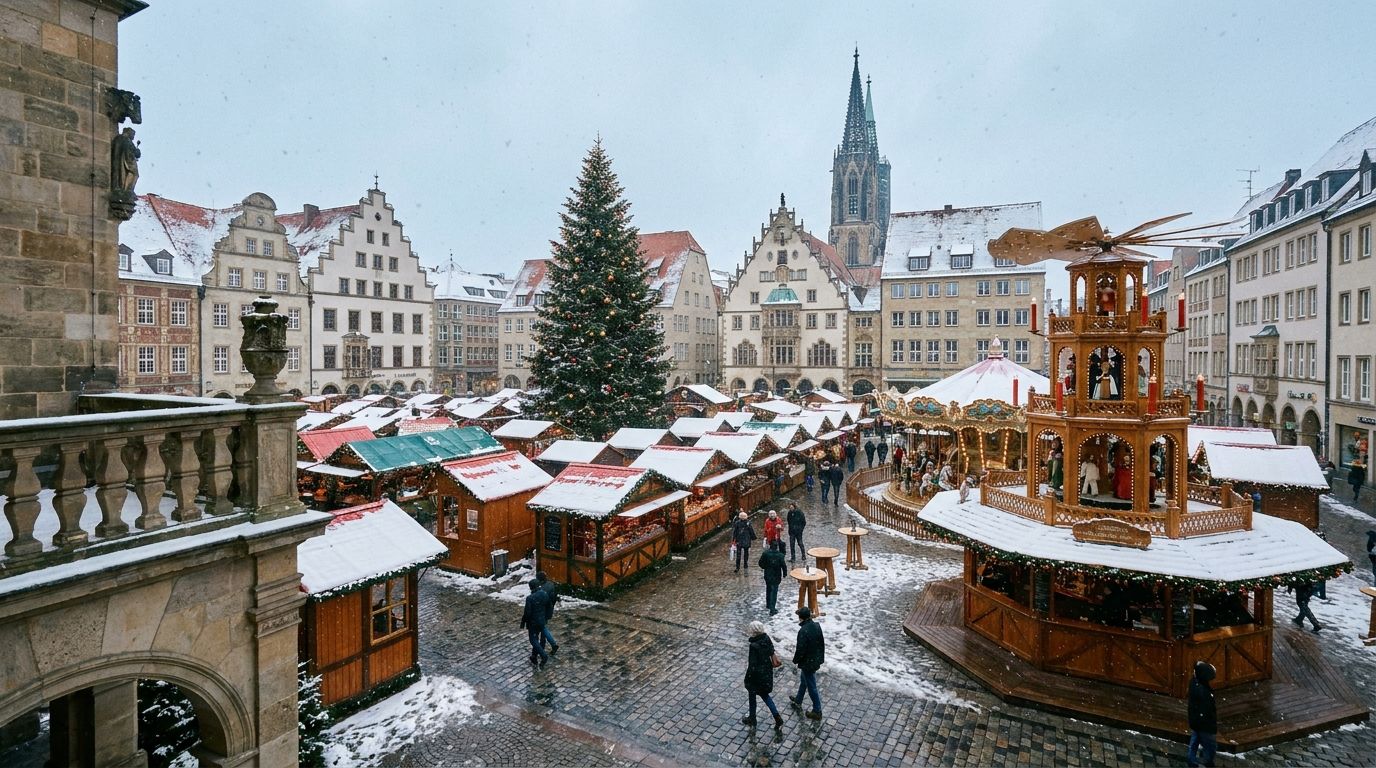
A Christmas markets trip looks cheap when you plan it. Mulled wine is three euros, the stalls are free to walk around, and everyone pictures a long weekend that costs about as much as a weekend at home.
In practice the bill is driven by December accommodation, train fares booked late, and five evenings of small purchases in two currencies. This post gives a per-person budget in three tiers for five nights across Prague and Vienna, the costs people forget to plan for, and how a group keeps the small stuff straight.
How much does a Christmas markets trip cost? The short answer
For five nights split between two cities, budget roughly 485 euros per person on a hostel and advance train fare budget, about 985 euros for a comfortable central mid-range trip, and around 2,030 euros at the premium end. Flights are on top.
The single biggest lever is which cities you pick. Prague and Budapest run at roughly half the accommodation and food cost of Vienna, Munich or Strasbourg, and the markets are every bit as good. A Prague and Vienna pairing gets you one cheap base and one expensive one, which is why it is the classic route.
The example below is a group of four, five nights, two nights in Prague and three in Vienna, traveling in the first half of December:
| Per person, 5 nights | Budget | Balanced | Premium |
|---|---|---|---|
| Accommodation | 200 EUR | 425 EUR | 900 EUR |
| Market food and drink | 90 EUR | 150 EUR | 260 EUR |
| Other meals and cafes | 75 EUR | 150 EUR | 300 EUR |
| Train between cities | 25 EUR | 60 EUR | 130 EUR |
| City transport | 25 EUR | 35 EUR | 80 EUR |
| Entries, concerts, gifts | 50 EUR | 130 EUR | 300 EUR |
| Deposits, tips, small stuff | 20 EUR | 35 EUR | 60 EUR |
| Total per person, excluding flights | about 485 EUR | about 985 EUR | about 2,030 EUR |
For reference, US travel sites price a moderately priced one-week markets trip for two at roughly 4,000 euros all in, and long-haul flights push the same trip to 5,500 or 6,500 euros. Organized markets tours run about 2,300 to 3,100 euros per person including flights, which is a useful ceiling to compare your own plan against.
The full cost breakdown
Accommodation
This is where the east-west gap shows up most clearly. A central mid-range twin-share room costs about 90 to 120 euros per person per night in Vienna and Munich, and 50 to 80 in Prague. Across two nights in Prague and three in Vienna, that averages out near 85 euros a head per night, which is the balanced figure in the table.
For a group of four, an apartment usually beats two hotel rooms, and it gives you somewhere to warm up and to leave the gifts. It also puts the entire accommodation cost on one person's card, which is the part to plan for.
Book by early autumn. December weekends in market cities sell out, and the last two weekends before Christmas are the most expensive of the season.
The markets themselves
Entry is free everywhere. An evening at a market, meaning a couple of mulled wines, something hot to eat and a bag of roasted almonds, costs 15 to 25 euros in Western Europe and closer to 10 to 15 euros in Prague. That is genuinely the cheapest part of the trip, which is why it is also the part where the spending gets invisible.
The balanced tier assumes a bigger evening than that, three or four drinks and a proper hot meal, at about 30 euros. Five evenings at 30 euros is 150 euros a head, the balanced number in the table. It goes up fast if the group treats every stall as a shared round, because a round of four mulled wines is 15 euros and you will buy several a night.
Getting between cities
Trains are the right answer on this route and the price depends entirely on when you book. Advance fares on central European routes, sold as Sparschiene by Austrian Railways and under similar names by Czech Railways and Deutsche Bahn, start around 18 to 25 euros. The same Prague to Vienna leg bought at the station on the day is closer to 80 euros.
For three or four fixed legs, point-to-point tickets booked two to three months ahead beat a rail pass. A pass only wins if your plans are still genuinely undecided, which on a five-night trip with booked hotels they are not.
Everything else
City transport is cheap and worth buying as multi-day passes on arrival: about 13 euros for a three-day pass in Prague and about 17 euros for 72 hours in Vienna. Museums, tower climbs, a Christmas concert in a church and an ice rink session are the usual paid extras, and 130 euros covers a comfortable amount of that over five nights.
Gifts are the wildcard. This is a shopping trip whether you planned one or not, and gift spending is the line most likely to double the personal side of the budget.
What nobody budgets for at a Christmas market
The mug deposit. Mulled wine is served in a real ceramic mug with a deposit of roughly three to five euros, refunded when you return it. Half your group will keep the mug as a souvenir, which quietly turns a deposit into a purchase, and the person who returns four mugs gets a refund that belongs to four different people.
Cash. Plenty of market stalls are still cash-only, and in Prague and Budapest that means a currency you will not spend anywhere else. Airport exchange desks are the worst possible way to get it. Withdraw a small amount of koruna from a bank ATM in the city, decline the ATM's offer to convert to your home currency, and let the euro part of the trip go on cards.
Two currencies on one trip. Prague charges in koruna and Vienna in euros, so a single evening's expenses can be in two currencies and nobody agrees afterwards on which rate to use.
The mid-December flight cliff. Fares hold steady through late November and then step up sharply as the school holidays begin. Traveling in the first half of December is the single easiest saving on the whole trip, and the markets are quieter too.
Baggage for the way home. Four people who bought gifts need more luggage allowance than four people who did not. Add a checked bag when you book the flight, because buying it at the airport on the way home costs two to three times as much.
How the three tiers actually feel
| Budget | Balanced | Premium | |
|---|---|---|---|
| Sleep | Hostel or a shared apartment outside the center | Central twin-share hotel or a good apartment | Boutique hotel on the square |
| Eat | Market food is dinner, supermarket breakfast | Market food most nights, two proper restaurant dinners | Restaurants booked ahead, market food as a snack |
| Drink | Two mulled wines an evening, mugs returned | Three or four an evening, one mug kept | Rounds without counting, mugs kept |
| Travel | Advance fare booked months ago, second class | Advance fare, second class, flexible enough | First class or booked late, taxis to stations |
| Do | Walking, free churches, the markets themselves | A concert, a museum, the ice rink | Concerts, tours, a spa afternoon |
| Per person | about 485 EUR | about 985 EUR | about 2,030 EUR |
Splitting a markets trip, where everything is small and constant
This trip has the opposite money shape to a festival or a race weekend. There is no single big ticket. Instead there are two or three large prepayments and then about forty tiny purchases per person, half of them in cash, across two currencies, in the dark, wearing gloves.
That is the hardest kind of trip to reconstruct afterwards, and it is why most groups give up and split the whole thing equally. Which is fine, right up until one person did not drink, one person bought all the gifts, and one person quietly paid for every round for five nights.
Three rules make it work. Log the apartment and the train tickets the day they are paid. Treat rounds as shared expenses recorded on the spot, not as favors to be remembered. And decide up front that gifts for people outside the group are personal, not shared, because that is the argument that actually happens.
Then settle once at the end, in one pass, rather than four people transferring odd amounts to each other. If you want the mechanics of that last step, who owes who after a group trip walks through the math.
How groups keep it straight in two currencies
A markets trip is the exact case HippoSplit was built around: lots of small expenses, captured in the moment, by whoever happened to pay.
Type "gluhwein round 15 split with Anna, Ben and Kim" into the group chat while you are still standing at the stall and it is logged and split. Or post a photo of the stall receipt straight into the chat, the same way you would send a picture to friends, and HippoSplit reads it and files the expense with its items and total. With cold hands and a mug in the other one, the photo is the habit that actually survives the evening.
Koruna and euros in the same trip sort themselves out, because HippoSplit handles 150 plus currencies at live rates and converts as it goes. Nobody has to agree on a rate at the end, and nobody has to do mental math at a stall.
For an expense where the split is not even, caption the photo with what happened, for example "gifts mine, food shared four ways", and the split follows the caption. And the friend who refuses to install anything can open the group from a link and follow the running total as a guest without signing up; they see everything, and adding expenses needs a free account.
Christmas markets cost FAQ
When are the European Christmas markets open in 2026?
Most open in the second half of November and close on 24 December, with a handful running into early January. Dates vary city by city and are published in the autumn, so check the specific markets on your route before booking flights around them.
How much spending money do I need per day?
Around 45 to 70 euros a day per person covers market food and drink, a proper meal and city transport, before accommodation. An evening at the market on its own is 15 to 25 euros. Gifts sit outside that and are entirely up to you.
Which Christmas market cities are cheapest?
Prague and Budapest are consistently the best value, at roughly half the accommodation and dining cost of Vienna, Munich, Strasbourg or Zurich. Pairing one cheap base with one expensive one is how most groups get a great trip without a Western European price tag throughout.
What is the mug deposit?
Mulled wine comes in a real ceramic mug, and you pay a deposit of about three to five euros on top of the drink. Return the mug and you get it back; keep it and you have bought a souvenir. Budget for keeping one or two per person and returning the rest.
Is a rail pass worth it for a markets trip?
Usually not. For three or four fixed legs booked two to three months out, advance point-to-point fares from around 18 to 25 euros beat a pass comfortably. A pass only makes sense if you genuinely have not decided your route.
What does a markets trip cost for a group of four?
At the balanced tier, about 985 euros each, so roughly 3,900 euros for four people over five nights before flights. An apartment instead of two hotel rooms and traveling in the first half of December are the two changes that move the number most.
The bottom line
A Christmas markets trip is cheap per evening and expensive per week, and that gap is exactly why people are surprised by the bill. The markets are not what costs money. December accommodation, late-booked trains and five nights of small untracked rounds are.
Book the beds and the trains early, go in the first half of December, pick one affordable city to balance the expensive one, and log the small stuff as it happens. The general playbook for any group trip is in how to split trip expenses with friends.
Planning one for December? Start a HippoSplit group, drop the apartment booking in on the day you pay it, and let the two currencies take care of themselves.