How to split a bill: restaurant math for tax, tip, and shared dishes
One multiplier handles tax and tip fairly. Worked examples for shared appetizers, the friend who only had a drink, service charges, and big-table rounding.
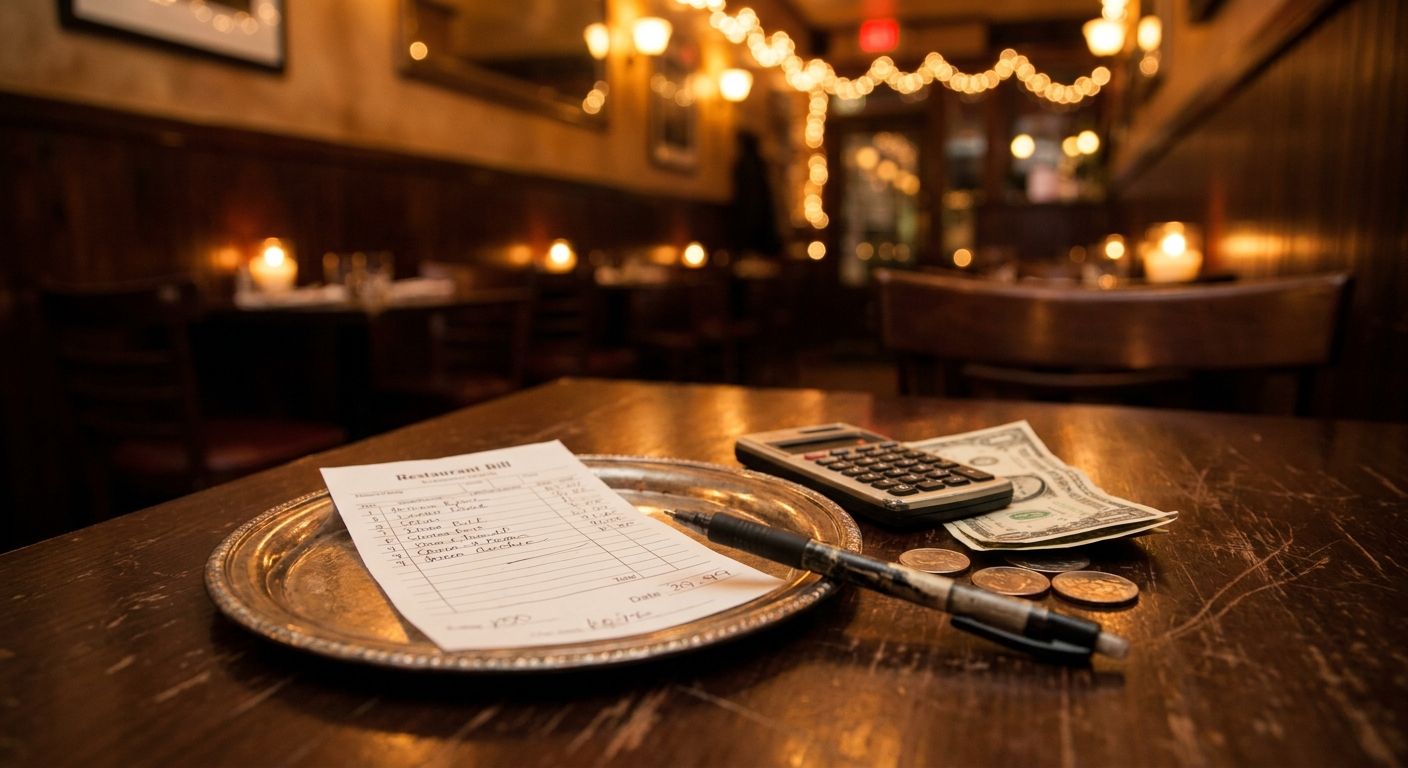
The bill lands and someone starts doing arithmetic out loud. The food part is easy, everyone knows roughly what they ordered. The part that goes wrong is tax and tip, which get split evenly out of habit even when the orders were nothing alike, and that quietly overcharges whoever ate least. This guide is the restaurant math: one multiplier that allocates tax and tip in proportion to what each person ordered, plus worked examples for the cases that actually cause the argument.
The short answer
Add up each person's own items, then multiply by one number: the final total divided by the subtotal. That multiplier folds in tax and tip proportionally, and the shares add back to the exact bill. If everyone ordered roughly the same thing, skip all of it and divide the total by the number of people. Picking between splitting methods more generally, equal, by items, percentages, or custom shares, is a separate decision covered in our guide to splitting group expenses fairly.
Prefer to have the multiplier done for you? Our free bill split calculator does exactly this in the browser: enter the bill, tax, and tip, split evenly or by what each person ordered, and the shares always add up to the exact total.
The one formula: the proportional multiplier
Tax is charged on the whole bill and tip is usually a percentage of it, so the person who ordered more should carry more of both. Splitting the food by items but the tax and tip evenly is the most common mistake at a restaurant table, and it always favours the big orders. The fix is a single number:
multiplier = final total / subtotal, then each person pays their own items times the multiplier.
Worked example. Four friends, subtotal $84.00, tax at 8% adds $6.72, an 18% tip on the subtotal adds $15.12, so the final total is $105.84. The multiplier is 105.84 / 84.00 = 1.26.
| Person | Their items (subtotal) | x 1.26 multiplier | They pay |
|---|---|---|---|
| Alex | $30.00 | 30.00 x 1.26 | $37.80 |
| Ben | $22.00 | 22.00 x 1.26 | $27.72 |
| Chloe | $18.00 | 18.00 x 1.26 | $22.68 |
| Dana | $14.00 | 14.00 x 1.26 | $17.64 |
| Total | $84.00 | $105.84 |
The shares add back to the exact total, tax and tip included, and everyone paid in proportion to what they ordered. Compare that to an even split of $26.46 each: Dana would have subsidised Alex by nearly nine dollars on a single dinner.
Tip: before or after tax, and how much
US convention is to tip on the pre-tax subtotal, typically 15% for adequate service, 18% to 20% for good service. Card terminals usually suggest percentages of the post-tax total instead, which nudges the tip a few percent higher than you intended. Either basis is defensible, just decide it before you calculate. The multiplier does not care: whatever tip ends up on the bill, dividing the final total by the subtotal spreads it across the table in proportion to each person's order.
Service charges and automatic gratuity
Many restaurants add an automatic gratuity of 18% to 20% for parties of six or more, and plenty add a separate service charge or a kitchen fee. These are already printed on the bill, so they land in the final total and the multiplier allocates them for you with no extra step. Two things to watch: check the line items before adding a tip on top, because paying twice is easy when the terminal still prompts you, and remember that in much of Europe service is included by default, so the multiplier is doing the whole job.
The four situations that cause the argument
Almost every disputed restaurant bill is one of these. Handle the item assignment first, then apply the multiplier to whatever each person ends up owning.
| Situation | What to do | The math |
|---|---|---|
| Shared appetisers and a bottle of wine | Divide each shared line among the people who actually had it, then add it to their own items | $36 wine / 3 drinkers = $12 each, added before the multiplier |
| One person only had a drink | Pull their item out first and apply the multiplier to it alone | $8.00 x 1.26 = $10.08 |
| Someone arrived late or skipped a course | Charge them only the lines they were present for | Their items x the same multiplier |
| Someone cannot pay right now | One person fronts the whole bill and the group squares up after | Record who fronted so it rotates over time |
When an even split is fine
Not every bill deserves the multiplier. If the orders were similar, the bill is small, or the group eats together often enough that it averages out, dividing the total by the number of people is fair enough and takes five seconds.
The rule of thumb: if the gap between the biggest and smallest order is under about 20% of the average, even split. Above that, do the math. Standing arrangements like roommate utilities or income-weighted shares are a different problem entirely, and belong in a percentage split agreed once rather than recalculated per bill.
Big groups: rounding, pennies, and who covers the gap
Divide $105.84 by four and you get clean numbers. Divide a $173.20 bill by seven and you get $24.742857. Round everyone up to $24.75 and the group overpays by a few cents, which is fine as extra tip. The person who fronted the bill should never be the one who eats the rounding gap, so round in their favour by default.
For groups of six or more, the practical move is one person pays the whole bill and everyone squares up afterwards. That turns a table-side math session into a single transfer each, and nobody is chasing seven people for $24.75.
Or skip the math: post the receipt, or just say it
Everything above is arithmetic nobody should have to do while a waiter waits. That is what HippoSplit is for. The group has a normal chat, and anything you drop into it becomes the expense record. No form, no calculator, no one appointed treasurer for the evening.
Post the photo and say what happened. Drop a picture of the receipt into the chat, the same way you would send a photo to friends, and add one line with it: "Tip 20% added, Paul had the steak, Mary had the pasta, the rest split even." HippoSplit reads the receipt for the line items, total, currency and date, adds the tip as its own line on top, assigns the steak to Paul and the pasta to Mary, splits everything nobody claimed across the whole group, picks a category, records you as the one who paid, and saves the expense. You did not open a form, type an amount, or work out a multiplier.
Or skip the photo. No receipt to hand, or paying at the bar? Type it the way you would say it out loud: "Dinner 105.84 including 20% tip, I paid, Paul had the steak, Mary had the pasta, the rest split even." Same result, same one message. The tip lands as its own line either way, so the group can see exactly what they are splitting.
Tax and tip follow the items on their own. HippoSplit recognises tax, service charge, tip and discount rows as fees rather than dishes, and by default spreads each one proportionally to what every person ordered: the same multiplier logic as above, with nobody doing the division. If a fee should work differently, switch just that fee to an equal split, only among chosen people, or custom amounts.
The AI only reads. It picks the numbers off the receipt and out of your message, and HippoSplit does the actual sums itself, so nobody is trusting a chatbot with the money. Then, when the weekend is over, it works out the shortest way to settle up. Instead of eleven small transfers going round in circles, most groups end up sending one or two.
That is the part worth the time. The multiplier takes thirty seconds when somebody remembers to do it. Logging fifteen bills across a weekend, chasing the two people who forgot, and reconstructing who owes whom on the flight home is what actually costs you an evening.
Frequently asked questions
Should tax and tip be split evenly or proportionally?
Proportionally, whenever you are splitting the food by items. Use the multiplier: final total divided by subtotal, times each person's items. If you are splitting the whole bill evenly anyway, tax and tip are automatically even too.
What is the fairest way to split a restaurant bill?
By items, with tax and tip allocated proportionally, as in the worked example above. Fair does not always mean worth it though: for small bills among regulars, an even split is fair enough and much faster.
How do you split a bill when someone only had a drink?
Take their item out first, apply the multiplier to just that, and split the rest among everyone else. "You had the $8 beer, times 1.26, call it $10" takes ten seconds and nobody feels taxed for showing up.
Is tip calculated before or after tax?
Convention in the US is to tip on the pre-tax subtotal, though many people tip on the after-tax total for simplicity. Either way, the proportional multiplier handles it: it spreads whatever tip you chose across the group in proportion to what each person ordered.
Do you tip on top of a service charge?
Usually not. If the bill already carries an automatic gratuity or service charge of 18% to 20%, that is the tip, and the card terminal prompting you again is not evidence that it is missing. Read the line items before adding more.
What is the easiest way to split bills on a group trip?
Log every shared cost as it happens and settle once at the end instead of calculating each bill at the table. Our guide to splitting trip expenses with friends covers the full workflow, including multiple currencies.
Skip the table-side math next time
Start a free HippoSplit group and let the next bill split itself from a photo of the receipt. Still weighing options? Our roundup of the 7 best expense splitting apps compares the field honestly.