Roommate bill splitting: how to set up recurring rent, utilities and subscriptions
Rent is easy. The bills that wear roommates down are the ones that change and repeat. A bill inventory, the utility rules that stay fair, and a monthly cycle that runs itself.
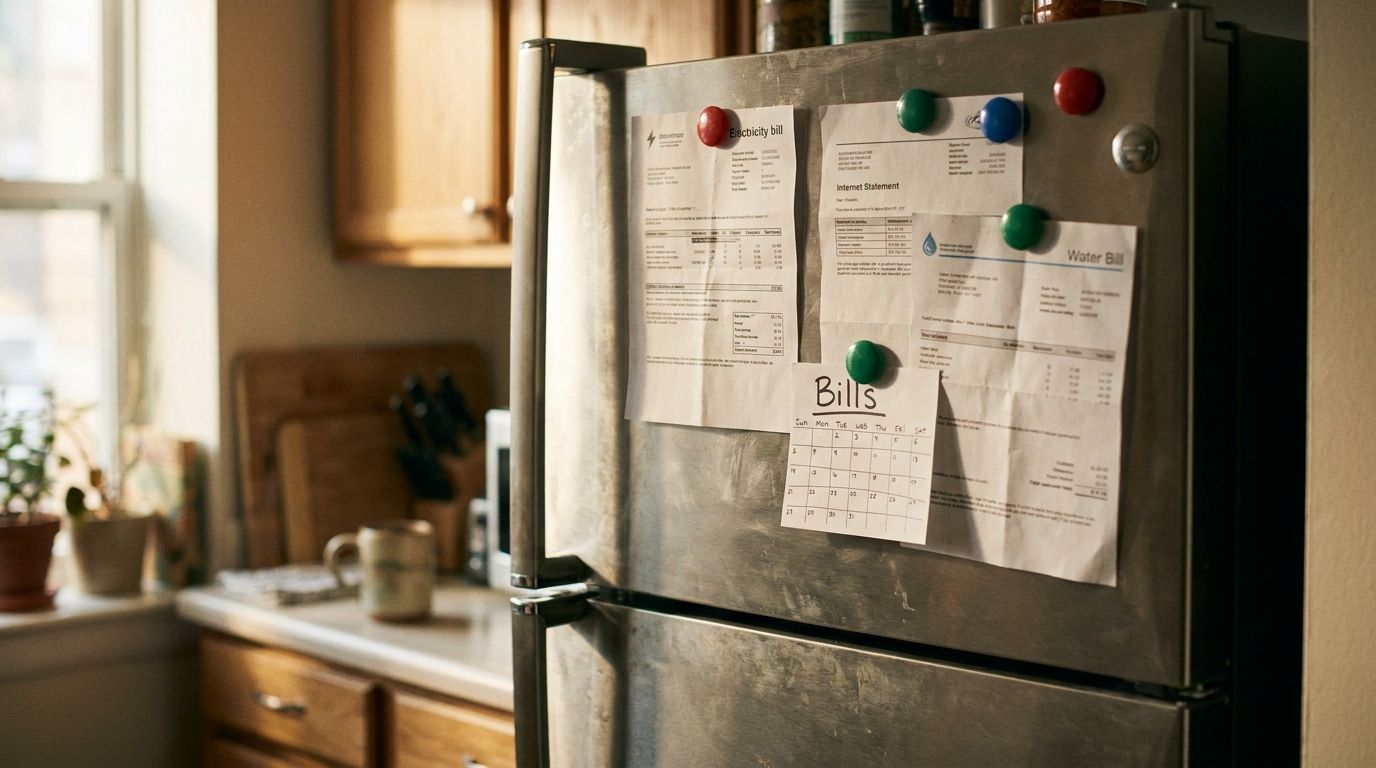
Rent is the easy one. It is the same number on the same day, and everyone knows it is coming. The bills that actually wear roommates down are the ones that change every month and arrive on five different dates: the electricity bill that doubled in July, the internet that is in one person's name, the streaming subscription two of you use and one of you pays for, and the water bill nobody remembers exists until the landlord forwards it.
This guide is about building a system for those recurring bills, so they split themselves and nobody has to be the household accountant. If you are still deciding how to divide the rent itself, or whether to share groceries, that is covered in our guide to splitting rent and bills with roommates fairly. Here we assume the method is agreed and focus on making it run every month without friction.
The short answer
List every bill that repeats, write down who holds the account for each one, and agree one split per bill (utilities usually split equally, subscriptions only among the people who use them). Then move the whole list into one place that can repeat it automatically, a roommate bill splitting app or a shared spreadsheet, and pick a single settle-up day each month. Once that exists, a new bill is a thirty-second job: update the amount, the split is already set, and the balances tell everyone what to transfer. The work is all in the setup, which takes about twenty minutes and is best done before the first bill arrives, not after the first argument.
Start with the bill inventory
Most roommate money trouble comes from bills nobody agreed on because nobody listed them. Sit down together once and fill in a table like this one. Three columns matter more than the amounts: who is on the account, how often it comes, and whether it is fixed or variable.
| Bill | Typical cycle | Fixed or variable | Who usually holds the account |
|---|---|---|---|
| Rent | Monthly, fixed date | Fixed | Everyone on the lease, or one person pays the landlord |
| Electricity and gas | Monthly or bimonthly | Variable, seasonal | One roommate |
| Water and sewer | Monthly or quarterly | Variable, often via landlord | Landlord or one roommate |
| Internet | Monthly | Fixed | One roommate |
| Renters insurance | Monthly or annual | Fixed | Often per person, sometimes shared |
| Streaming and music subscriptions | Monthly | Fixed | Whoever signed up |
| Cleaning service, shared supplies, pest control | Monthly or ad hoc | Semi-variable | Rotates, which is the problem |
The account-holder column is the one people skip, and it is where the real risk sits. Whoever's name is on the electricity account is legally responsible for the whole bill, and their credit takes the hit if a roommate is late. Spread the accounts around so no single person carries all of them, and treat "I pay the provider, you pay me" as a loan that needs a visible record, not a favor.
How to split utilities between tenants
Utilities are the bills that cause arguments, because they move. The default that works for most households is an equal split of the total, regardless of who showered longer. Usage is impossible to meter per person in a normal apartment, and trying to argue about it costs more goodwill than the few dollars at stake. Equal is fair enough and, more importantly, it is predictable.
There are three situations where equal stops being fair and a different rule is worth the extra conversation:
- Someone is away for a long stretch. A roommate who spends six weeks abroad should not pay a third of the summer air-conditioning bill. Agree a threshold up front, for example any absence over two weeks, and prorate that person's share of the variable bills by the days they were present. Fixed bills like internet stay on the full split, because the service was available to them the whole time.
- One room drives one bill. A roommate who runs a space heater, a mining rig, or a home studio can push the electricity bill up alone. The honest fix is a named surcharge on that bill, for example that person pays 50 percent and the rest is split equally, agreed once and written into the recurring expense so nobody renegotiates it every month.
- Incomes are very different. Some households split variable bills proportionally to income, the same way they might split rent. It works only if everyone is comfortable sharing numbers. We cover the math in a separate guide to splitting bills based on income.
Two practical rules stop utilities from generating surprises. First, the account holder posts the bill the day it arrives, not the day it is due, so nobody finds out about a spike two weeks late. Second, set a "heads-up" threshold, for example any bill more than 30 percent above the previous month, that triggers a quick message before it is logged. Most utility fights are not about the money, they are about learning of a $240 bill after it has already been paid.
Mid-month move-ins and move-outs
When someone joins or leaves partway through a billing cycle, prorate by days. A $90 internet bill for a 30-day month is $3 per day; a roommate who moved in on the 21st owes 10 days, or $30, and the existing roommates split the remaining $60. Utilities work the same way, using the billing period printed on the statement rather than the calendar month. Agree on this rule before anyone moves, because it is far easier to accept a formula in the abstract than when it costs you $40.
Subscriptions: the bills that are not household bills
Streaming, music, cloud storage, a shared meal-kit box. These are the bills that quietly go wrong, because they are small, they are on one person's card, and the people using them change. The rule that keeps them clean is simple: a subscription is split only among the people who actually use it, and the split is revisited every time someone signs up or drops off.
In practice that means three or four tiny recurring expenses, each with its own member list. The $17.99 streaming plan split between the two people who watch it. The $10.99 music family plan split across all four. The cloud storage that only one person uses is not a household bill at all and should never appear on the shared list. Writing this down once ends the "but I never watch it" conversation permanently, because the person who does not watch it is simply not on that split.
Build the monthly cycle
A recurring bill system has three moving parts: a place where every bill lives with its split already set, a fixed day when balances are settled, and a way to log the one-off shared costs that appear between bills (the new shower curtain, the plumber, the replacement kettle). Get those three right and the month runs itself.
| Step | What to do | How often |
|---|---|---|
| 1. Enter each bill as a recurring expense | Amount, who paid the provider, who it is split among, the schedule | Once, during setup |
| 2. Update variable amounts | When the electricity or water statement arrives, edit that month's amount | Each time a bill lands |
| 3. Log one-off shared costs | Type it or post the receipt the moment it happens | As they happen |
| 4. Settle on one day | Everyone transfers their net balance, not bill by bill | Once a month, for example the 1st |
| 5. Review the list | Add or remove subscriptions, adjust splits for absences | Quarterly, or when someone moves |
Step 4 is the one that saves the most energy. Without it, roommates pay each other for every bill separately, five or six transfers a month each way. With one settle day and a tool that nets the balances, most months end in a single transfer per person. It also gives the household a natural moment to notice a bill that has not been posted.
A roommate bill splitting app versus a spreadsheet
Both work. The question is how much of the system you want to maintain by hand.
A spreadsheet is free, transparent, and everyone already knows how it works. Its weakness is that nothing repeats on its own: someone has to copy last month's rows into this month, chase the variable amounts, and recalculate who owes whom. That someone is always the same person, and the system lasts exactly as long as their patience. If you want to go this route, our free expense-splitting spreadsheet template has a settle-up tab built in, so the netting math at least is done for you.
An app earns its place when bills repeat, which for a household is nearly all of them. In HippoSplit, your household is a group chat. Set rent, internet, electricity and the subscriptions up once as recurring expenses, each with its own amount, split, and schedule (weekly, biweekly, monthly or yearly), and they log themselves from then on; when the electricity statement arrives, you edit that month's amount and everyone's balance updates. One-off costs go in as messages: type "plumber 140 split even" like a normal text, or post a photo of the hardware store receipt straight into the chat, the way you would send a picture to your roommates. HippoSplit reads the photo, pulls out the items and total, and logs the expense. If one roommate bought their own things on the same receipt, assign those lines to them and any tax or service charge on the receipt is spread in proportion to what each person actually bought, rather than equally. Balances net down to one transfer per person on settle day, and roommates who refuse to install anything can follow along from a shared link in their browser.
Two honest limits. Guests who join from a link can see everything but cannot add expenses, so at least the account holders need a free account. And HippoSplit does not pay the bills or move money; it keeps the record and tells everyone what to transfer.
A worked example: four roommates, one month
Here is what a typical month looks like once the system is running. Four roommates: Dana holds the electricity and internet accounts, Jo holds the streaming plan that three of them watch, Sam paid a $120 plumber visit mid-month, and Lee was away for the first two weeks.
| Bill | Amount | Paid by | Split rule | Dana | Jo | Sam | Lee |
|---|---|---|---|---|---|---|---|
| Rent | $2,400 | Each pays landlord directly | Equal, outside the shared record | - | - | - | - |
| Electricity | $160 | Dana | Equal, Lee prorated to 15 of 30 days | $45.71 | $45.71 | $45.71 | $22.86 |
| Internet | $80 | Dana | Equal, fixed, no proration | $20 | $20 | $20 | $20 |
| Streaming | $18 | Jo | Equal among Dana, Jo, Sam | $6 | $6 | $6 | $0 |
| Plumber | $120 | Sam | Equal | $30 | $30 | $30 | $30 |
| Total owed | $101.71 | $101.71 | $101.71 | $72.86 |
Dana paid $240 and owes $101.71, so Dana is owed $138.29. Jo paid $18 and owes $101.71, net Jo owes $83.71. Sam paid $120 and owes $101.71, net Sam is owed $18.29. Lee paid nothing and owes $72.86. On settle day the tool nets this down: Jo sends $83.71 and Lee sends $72.86, split between Dana and Sam so each is made whole, and the month closes in two transfers instead of eight. None of that required anyone to open a calculator, because the split rules were decided once, in setup.
Frequently asked questions
What is the fairest way to split utilities between roommates?
Equal split of the total is the default that works for most households, because individual usage cannot be measured in a normal apartment and arguing about it costs more than it saves. Move away from equal only for a clear, agreed reason: a long absence (prorate by days present), one room that drives one bill (a named surcharge), or a household that has chosen to split by income.
Should the person whose name is on the bill pay more or less?
Neither, but they carry the risk, so make it easy for them. The account holder is liable for the full amount and their credit suffers if others pay late. Spread the accounts across roommates rather than piling them on one person, post every bill the day it arrives, and settle on a fixed day so the holder is never floating the household for weeks.
How do you split bills when a roommate moves out mid-month?
Prorate variable bills by the days they lived there within the billing period printed on the statement, and treat fixed services like internet the same way unless your agreement says otherwise. Settle all balances before they hand over the keys, and remove them from every recurring split the same day so nothing accrues to them by accident.
Do roommates need a bill splitting app, or is a spreadsheet enough?
A spreadsheet is enough if one person is willing to maintain it every month and the household is small. An app is worth it as soon as you have several recurring bills, variable amounts, or roommates who will not keep a sheet updated, because the repeating and the netting happen on their own. A free tier covers a normal household either way.
How should roommates handle shared subscriptions?
Split each subscription only among the people who use it, as its own small recurring expense, and revisit the member list whenever someone joins or stops using it. Anything only one person uses is not a household bill and stays off the shared list.
Set it up before the first bill lands
The whole system is a twenty-minute conversation and a list: every bill that repeats, who holds it, how it splits, and one day a month when everyone settles. Put that list somewhere that can repeat it, whether a template or an app, and the rest of the year is mostly updating a number when a statement arrives. For the broader question of dividing rent and groceries, start with the roommate guide; for the whole system of splitting money with friends, the complete guide ties it together.