How to split expenses when your friends won't install an app
The one friend who refuses to install anything should not break your group's expense tracking. Four approaches that work when not everyone will download an app, and how to pick between them.
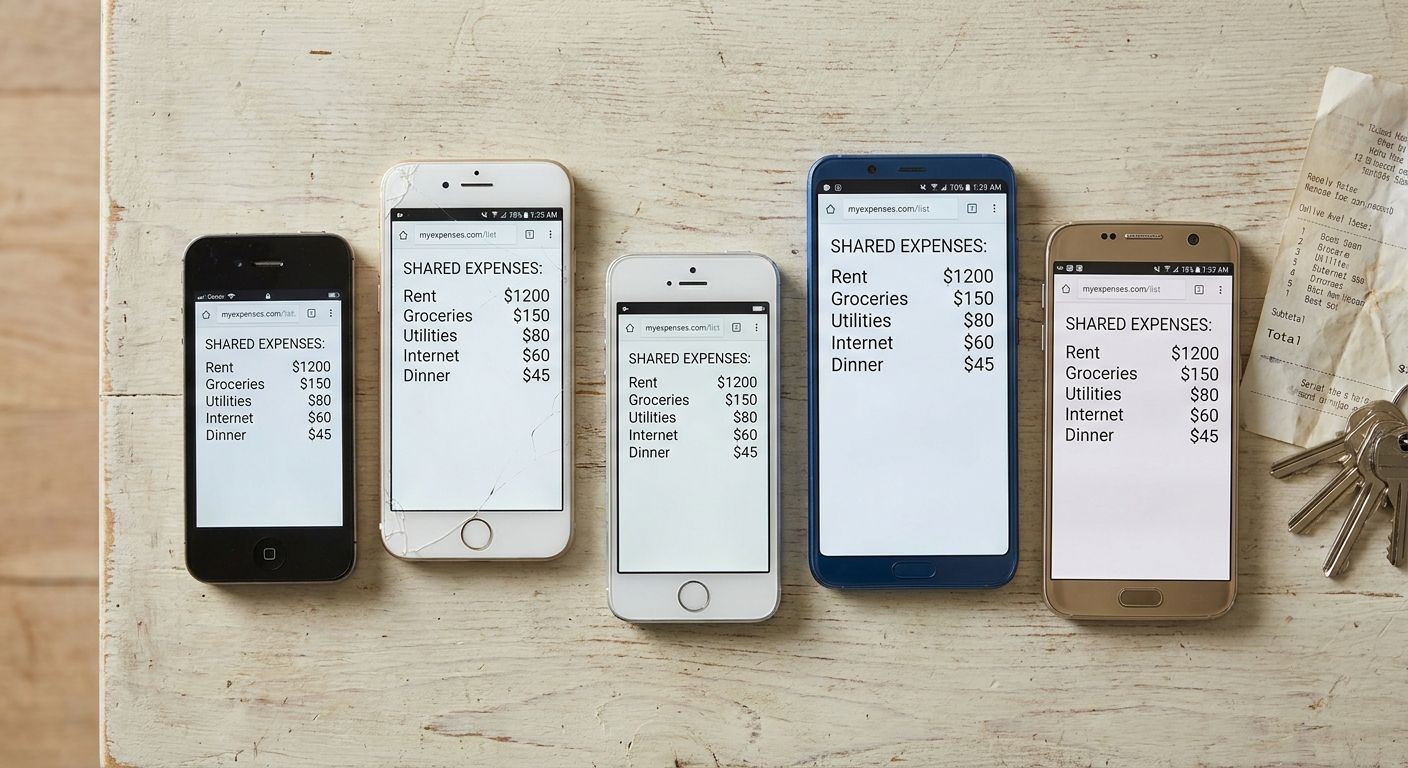
Every group has one. The friend who looks at the group chat, sees "download this and we'll track the trip properly", and quietly does nothing. Two days later they have paid for the taxi, the beach umbrellas and a round of drinks, none of it is written down anywhere, and the group is back to reconstructing the week from memory.
This is not stubbornness for its own sake. Most people already have too many apps, and installing one for a four-day trip feels like a bad trade. The mistake is treating it as a persuasion problem. It is a design problem, and it has four workable answers.
The short answer
Pick a tool that opens in a browser rather than one that has to be installed, and share it as a link. Anyone can then see the group and the balances without downloading anything or creating an account. If even that is too much, one person logs every shared cost while everyone else just glances at the running total, or you keep a shared spreadsheet, or for a single evening you skip tracking entirely and use a calculator once at the end. The rule that matters is not which tool you pick, it is that the record lives somewhere everyone can see. Group money goes wrong when the numbers live in one person's head, not when the app is imperfect.
Why "just install it" keeps failing
Group expense tracking has an unusual weak point: it is only as good as its least willing participant. One person who never logs anything does not reduce the record by one person's worth of accuracy, they undermine the whole thing, because now every total is suspect and someone has to chase them for amounts they half remember.
So the useful question is not how to convince that person. It is how to design the system so their reluctance costs the group nothing.
Option 1: a browser tool with a shareable link
The cleanest fix is choosing a tool that never asks anyone to install anything. Web-based splitters open in the browser your friends already have, and the good ones let you share a group by link or QR code so people can look without signing up first.
This is how HippoSplit works. It is a group expense tracker that runs entirely in the browser, on a phone or a laptop, with nothing to download. You create a group, drop the link into the chat you already use, and everyone can open it and see the expenses and balances as guests, with no signup at all.
Be clear about the limit, because it decides whether this works for your group: guest access is read-only. Guests can follow every expense and always know where they stand, but adding an expense takes a free account. In practice that is the right split of effort. The people happy to log things sign up, the reluctant friend never has to, and crucially they can still see the number they will be asked to pay, which is the part that actually causes arguments.
For the people who do log expenses, keep it fast enough to survive a holiday. Type "lunch 24.50 split with Anna and Ben" into the group chat like a normal message, or post a photo of the receipt straight into the chat, the way you would send friends a picture, and HippoSplit reads the items and amounts and logs the expense. The photo habit is the one that sticks, because it takes two seconds at the counter while you are still holding the receipt.
Option 2: one person logs, everyone else watches
If nobody but you will touch a tool, own it deliberately rather than by accident. You log every shared cost as it happens, and you share the running total with the group often enough that nobody is surprised at the end.
This works better than its reputation suggests, on two conditions. The others have to tell you what they spent, in the moment, in the chat: a message saying "paid 38 for the taxi" is enough. And you have to publish the balance regularly, not just at the end, because a number nobody has seen before feels like a bill, while a number everyone has watched climb feels like arithmetic.
The failure mode is the silent bookkeeper: someone quietly tracking everything for a week, then presenting a spreadsheet nobody has seen. Even when the maths is perfect it lands badly, because people are being told what they owe rather than watching it accumulate.
Option 3: a shared spreadsheet
A spreadsheet asks nobody to install anything and everybody already knows how to use one. Our free expense-splitting template handles up to six people, works in Excel and Google Sheets, and has balances and a settle-up tab already built, so nobody has to write formulas.
Its weakness is the moment of capture. Entering a row means opening a sheet on a phone, tapping into small cells, and getting the columns right, which is exactly the kind of friction that does not survive a third round of drinks. Spreadsheets are excellent for steady, predictable costs like a household's monthly bills, and poor for a fast-moving trip.
Option 4: do not track at all, just settle once
For a single dinner or one evening out, tracking is overkill. One person pays the whole bill, and you work out the shares once at the end. Our free bill split calculator runs in a browser with nothing to install and no account, splits evenly or by items, and shares tax and tip in proportion to what each person ordered.
The boundary is roughly one event. As soon as the costs span more than a day, or more than one person is paying for things, the mental version stops being reliable and you want a record of some kind.
Which one fits your group
| Situation | Best approach | Why |
|---|---|---|
| A trip where one or two people refuse to install anything | Browser tool, guest links for the reluctant | They see balances without signing up; the willing ones do the logging |
| Nobody but you will engage at all | You log, and publish the balance often | Keeps the record complete without needing anyone's cooperation |
| Steady monthly household bills | Shared spreadsheet | Predictable costs, entered at a desk, not at a bar |
| One dinner, one evening | Calculator at the end | Tracking is more effort than the problem deserves |
| Mixed group, some in, some out | Browser tool, and log on their behalf | Anyone can be added to an expense whether or not they use the tool |
One detail that makes the mixed case work: in a decent tool, a person can be part of an expense without being a user of the tool. You add them to the split, the balance counts them, and they pay you back at the end like anyone else. Their reluctance becomes a small extra typing job for you rather than a hole in the record.
How to raise it without nagging
Ask once, early, and frame it as less work rather than more. "I'll drop a link in here and log the shared stuff, you don't have to sign up for anything" gets agreement because it is a promise to do the admin, not a request for it. Then never mention installing again. Our group payment etiquette guide covers the rest of the conversations, including how to follow up on money without souring the trip.
What usually happens is that the reluctant friend opens the link a few times to check what they owe, decides it is useful, and signs up on the second trip. Nobody has ever been argued into an app, but plenty of people have been shown one that was already doing something for them.
Frequently asked questions
Can you split expenses without downloading an app?
Yes. Web-based tools run in the browser everyone already has, so there is nothing to install on any phone or laptop. HippoSplit works this way: the group opens from a link, and friends can follow the expenses and balances as guests without signing up. Adding expenses needs a free account, but no one downloads anything at any point.
How do you track group expenses if only one person has the app?
That one person logs every shared cost, including the ones other people paid for, and shares the running balance with the group regularly. Others just message what they spent when they spend it. The record stays complete because being included in a split does not require using the tool yourself.
Is a spreadsheet good enough for splitting expenses?
For steady, predictable costs, yes. For a trip, usually not, because entering rows on a phone while out is exactly the moment people stop bothering, and a record with gaps is worse than no record because it looks complete. Use a spreadsheet where the entry happens at a desk, and something faster where it happens at a counter.
What if someone will not pay their share at the end?
A visible record prevents most of this, because the amount is never a surprise and never one person's word against another's. When it does happen it is usually a timing problem rather than a refusal, so send the number, the reason, and a payment method in one message, and give it a week before following up.
Start with the next shared bill
You do not need everyone's agreement to start. Create a group, drop the link in the chat, and log the next shared cost yourself. The people who want to join in will, and the ones who don't will still see exactly where they stand. Our complete guide to splitting expenses with friends covers the wider system, and you can start a group free in the browser right now, with 20 AI receipt scans a week and no download for anyone.