11 days in Japan in 61 receipts: what two people really spent
Two people, 11 days, 63 receipts: the full breakdown of the 414,700 yen (about $2,600) an April trip across Osaka, Kyoto, Tokyo, Fuji and Disneyland really cost, by category, by day and per person.
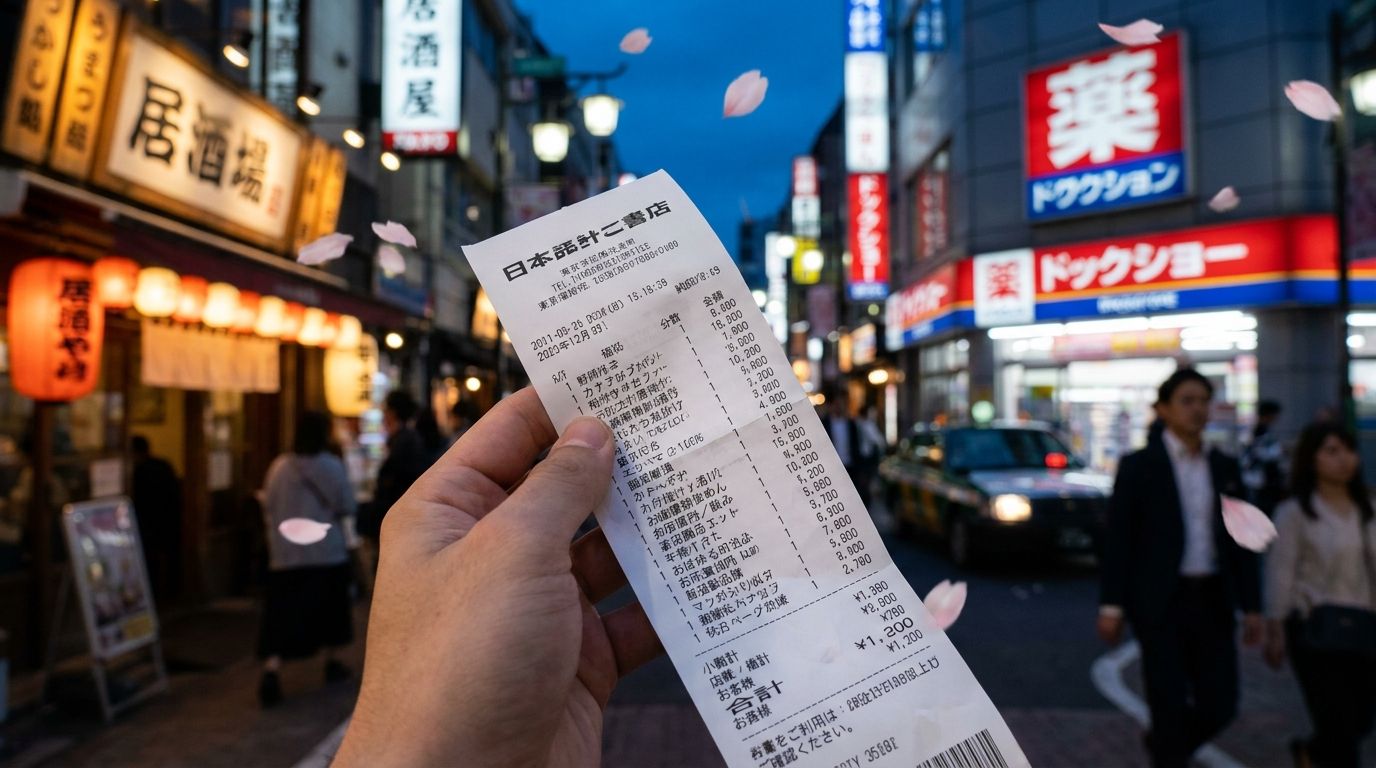
Most trip-cost posts give you a number someone remembered afterwards. This one is built from the receipts. For 11 days in Japan, from 4 to 14 April 2026, two of us logged every expense as it happened, from the two Airbnbs and the Shinkansen down to FamilyMart runs, a kimono rental, churros at Disneyland and a ¥108 bottle of water at Tokyo Station.
That comes to 63 expenses and 222 individual line items. What follows is the whole dataset, and the patterns that only appear when you look at line items instead of a monthly bank total.
How much does a trip to Japan cost? The short answer
Eleven days in Japan cost two people about ¥414,700, or ¥207,400 each, across Osaka, Kyoto, Tokyo, a Mt Fuji day trip and Tokyo Disneyland. At April 2026 rates that is roughly $2,600 or €2,230 for the pair, $1,300 or €1,115 each.
At a glance, the whole trip as a daily budget, per person, two of us in April, mid-range style:
| Per person per day | Yen | About USD |
|---|---|---|
| Accommodation | 7,900 | $50 |
| Food and drink | 3,300 | $21 |
| Transport | 2,900 | $18 |
| Activities and attractions | 2,100 | $13 |
| Gifts and souvenirs | 2,200 | $14 |
| Other small stuff | 400 | $2 |
| Total, excluding flights | 18,850 | $118 |
What each line covered, and the day-by-day version of the same numbers, are further down.
Accommodation was ¥173,800 of that, 42%, and the only part booked before we left home. The other ¥240,900 was spent once we landed, which works out at roughly ¥10,950 (about $69) per person per day. After accommodation the largest categories were food and drink at 17% and transport at 16%. Day to day the spending was small and frequent, with a median receipt of ¥2,500 and nine under ¥1,000, while a handful of large decisions carried the trip. Flights are excluded, because what they cost depends entirely on where you start.
For calibration, this was a mid-range trip, not a budget one and not a luxury one. We stayed in nice Airbnb units rather than hostels or hotels, grabbed breakfast at FamilyMart most mornings because it is quick and let us get out early, ate one or two restaurant meals a day and filled the gaps from the konbini and the supermarket, took trains everywhere and a taxi twice, and paid for the experiences we wanted, a kimono day, a Shinkansen to Mt Fuji, a day at Disneyland, without hunting for the cheapest version of any of them. If you travel the same way, these numbers should be close to yours. If you are hostel-and-ramen or ryokan-and-kaiseki, scale accordingly.
Adjust this for your trip
- Flights and travel insurance are not included, since both depend on where you are flying from. Add them on top.
- If you are travelling solo, or would pick hostels or business hotels over an Airbnb, the accommodation line roughly halves and the whole trip comes down by about 20%.
- Skipping Disneyland and the kimono day saves about ¥51,500 for two.
- Outside cherry blossom season, rooms are cheaper and the kimono surcharge disappears. Everything else on the ground costs the same.
The headline numbers
| Metric | Value |
|---|---|
| Trip | 11 days, 4 to 14 April 2026, two people |
| Expenses logged | 63 |
| Total cost for two | ¥414,700 |
| Per person | ¥207,400 |
| Booked before departure (accommodation) | ¥173,800 (42%) |
| Spent once we landed | ¥240,900 (58%) |
| Spend per day in Japan | ¥21,902, about ¥10,950 each |
| Largest single expense | ¥130,400, six nights in Tokyo |
| Largest receipt after accommodation | ¥28,800 Shinkansen Osaka to Tokyo, two seats |
| Median receipt | ¥2,500 |
The big items
Ranking all 63 expenses by size, seven of them are 67% of the trip. Two are the Airbnbs, booked before we flew, and between them they cost ¥173,800, very nearly as much as every meal, train, ticket and souvenir across the whole 11 days. The other five were decided in Japan.
| Item | Cost | About USD |
|---|---|---|
| Tokyo Airbnb, 6 nights | ¥130,400 | $820 |
| Osaka Airbnb, 4 nights | ¥43,400 | $270 |
| Shinkansen Osaka to Tokyo, two seats | ¥28,800 | $180 |
| Kimono rental for two, Kyoto | ¥24,310 | $150 |
| Shinkansen to Mt Fuji and back, two seats | ¥22,000 | $140 |
| Tokyo Disneyland tickets, two | ¥18,800 | $120 |
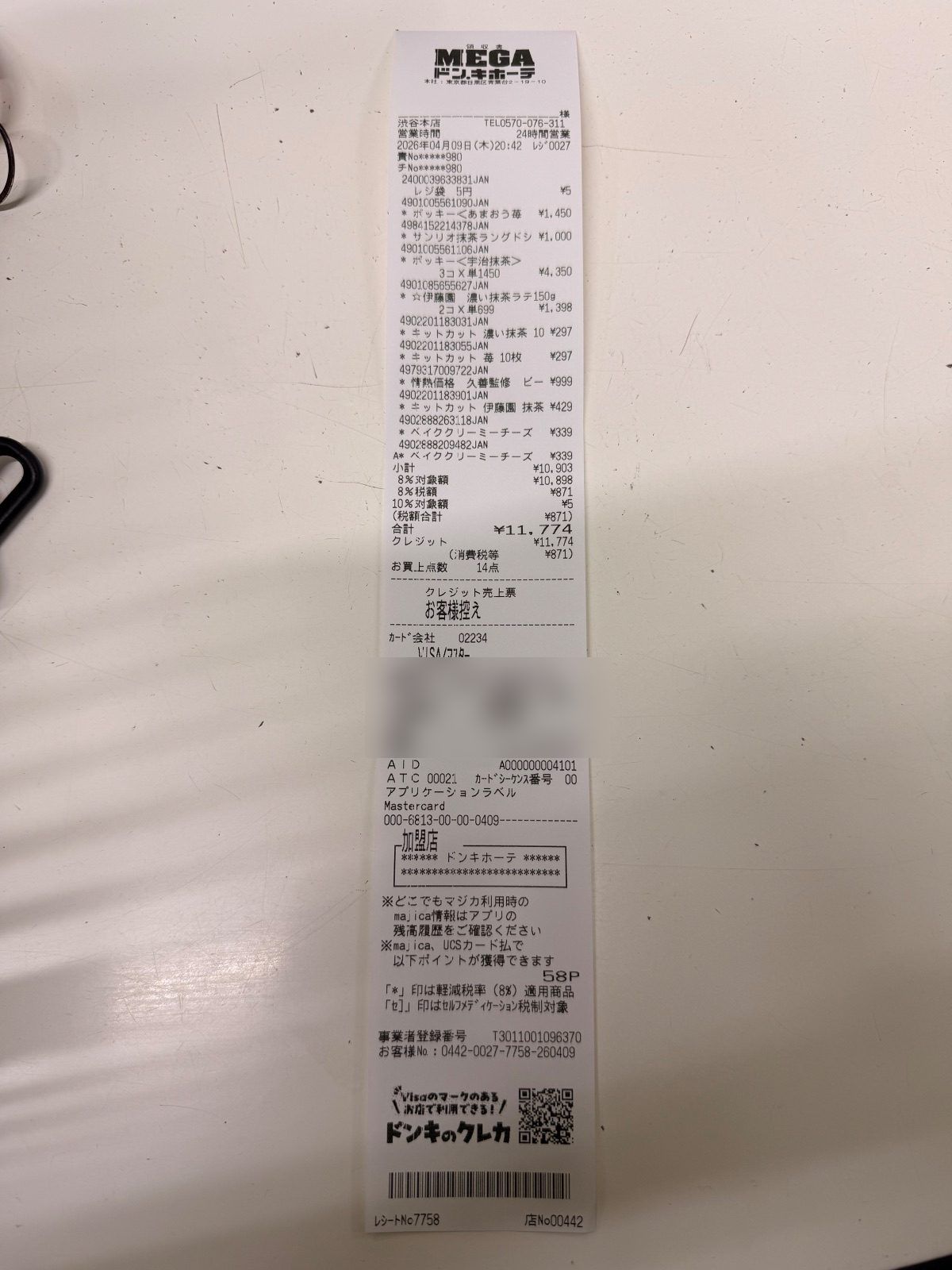
| Don Quijote Shibuya, 14 souvenir snacks | ¥11,774 | $75 |
| Total, seven expenses (67% of the trip) | ¥279,500 | $1,755 |
The other 56 expenses average about ¥2,400 each. That is the real split of a trip: a handful of decisions worth thinking hard about, and then dozens of small ones that are not worth a second of anyone's attention but still have to be recorded, because together they are a third of the money.
The Airbnbs, the Osaka to Tokyo Shinkansen and the Disneyland tickets were billed in Thai baht and are converted at the rate the card actually charged, ¥4.97 to the baht.
Where the money went
| Category | Yen | Share | Expenses |
|---|---|---|---|
| Accommodation | 173,813 | 42% | 3 |
| Food and drink | 72,354 | 17% | 33 |
| Transport | 64,641 | 16% | 9 |
| Activities | 46,710 | 11% | 3 |
| Gifts and souvenirs (snacks, cosmetics, Japanese goods) | 49,129 | 12% | 12 |
| Other | 8,090 | 2% | 3 |
Gifts are worth a closer look, because they were not only snacks. About ¥18,000 of that line is drugstore runs: cosmetics, skincare and other Japanese products bought as presents for people at home, which is a very normal part of a Japan trip and easy to forget when you are budgeting from the restaurant bills.
A Japan travel budget per person per day
The most reusable way to read the same data is per person per day: divide every category by two people and 11 days and you get a budget line you can copy into your own planning. Dollar figures use the April 2026 monthly average of ¥159 to the US dollar (¥186 to the euro), rounded.
| Category | Yen per person per day | About USD |
|---|---|---|
| Accommodation (Airbnb) | 7,900 | $50 |
| Food and drink | 3,300 | $21 |
| Transport (incl. two Shinkansen trips) | 2,900 | $18 |
| Activities (kimono, Disneyland, castle cruise) | 2,100 | $13 |
| Gifts and souvenirs | 2,200 | $14 |
| Other (umbrellas, luggage storage, a top) | 400 | $2 |
| Total, excluding flights | 18,850 | $118 |
Two things jump out. Food at ¥3,300 a head per day is lower than most people fear, and it was not a frugal ¥3,300: it covered a ¥7,600 seafood lunch, yakiniku, Ichiran and a steak dinner, balanced by konbini breakfasts. And the transport line is mostly two decisions, the Osaka to Tokyo Shinkansen and the Fuji round trip; strip those out and local trains, metro and the occasional taxi were about ¥630 a head per day.
The trip, day by day
| Date | Where | Yen | Expenses | What happened |
|---|---|---|---|---|
| Before departure | Booked online | 173,813 | 3 | Two Airbnbs, ten nights between them |
| Sat 4 Apr | Osaka | 8,214 | 4 | Land at KIX, Nankai to Namba, taxi, konbini |
| Sun 5 Apr | Osaka | 10,806 | 5 | Osaka Castle boat cruise, Dotonbori ramen, drugstore |
| Mon 6 Apr | Osaka | 13,030 | 9 | Busiest day for receipts: cafe, kushikatsu, four konbini stops |
| Tue 7 Apr | Kyoto and Osaka | 36,959 | 5 | Kimono day (¥24,310), yakiniku dinner |
| Wed 8 Apr | Tokyo | 31,539 | 3 | Shinkansen to Tokyo (¥28,791), a bottle of water and a supermarket run |
| Thu 9 Apr | Tokyo | 29,321 | 6 | Seafood lunch, Asakusa matcha, Don Quijote Shibuya |
| Fri 10 Apr | Kamakura and Tokyo | 12,501 | 5 | Rain: two umbrellas (¥4,580), Kamakura day trip |
| Sat 11 Apr | Tokyo | 5,757 | 3 | Quietest full day: matcha cafe, pho at Tokyo Station |
| Sun 12 Apr | Mt Fuji | 61,897 | 8 | Priciest day: Fuji Shinkansen ¥22,000, Disneyland tickets ¥18,800, steak dinner |
| Mon 13 Apr | Disneyland | 10,252 | 5 | Ears, curry, juice, churros, dinner on the way home |
| Tue 14 Apr | Tokyo | 20,648 | 7 | Last-day souvenirs, Ichiran, Uber to Haneda |
By place, counting each city's accommodation against it: Tokyo ¥209,742 (51%), Osaka ¥85,204 (21%), the Mt Fuji day trip ¥32,014 (8%), the Shinkansen between the two cities ¥28,791 (7%), Kyoto ¥27,227 (7%), Disneyland ¥27,200 (7%) and the Kamakura day trip ¥4,560 (1%). Tokyo takes half the trip almost entirely on the strength of six nights of accommodation; on the ground, Osaka was not far behind it.
Eight things the receipts show that a monthly total does not
1. The konbini was the most frequent stop, and one of the cheapest
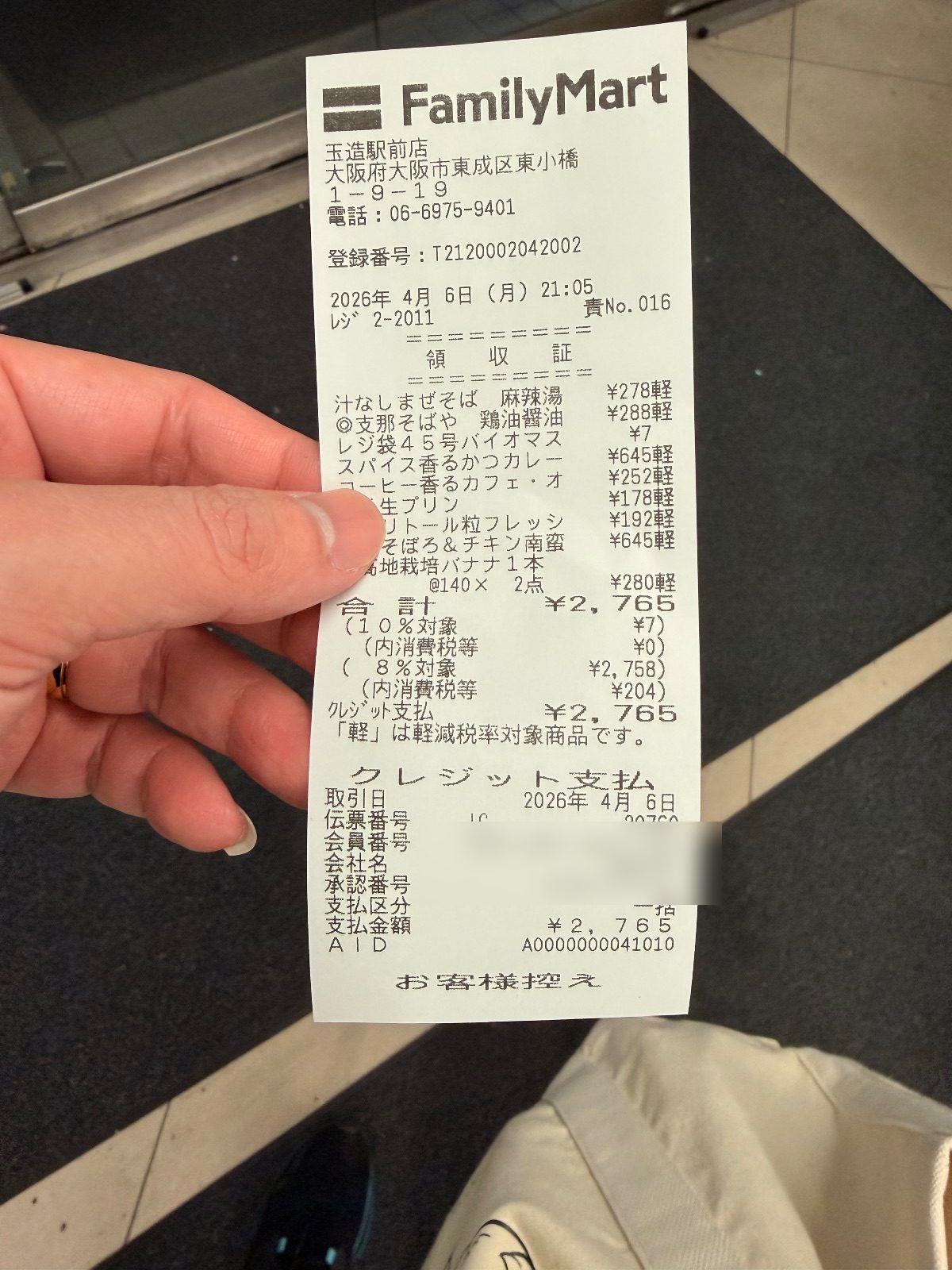
Twelve of our receipts are convenience stores, ¥19,567 in total, averaging ¥1,630. One FamilyMart, the one 200 metres from the Osaka Airbnb, appears six times on its own, including four visits on 6 April. In a monthly statement this is a blur of small card charges. On paper it is the clearest habit of the trip.
2. What a kimono day in Kyoto actually costs
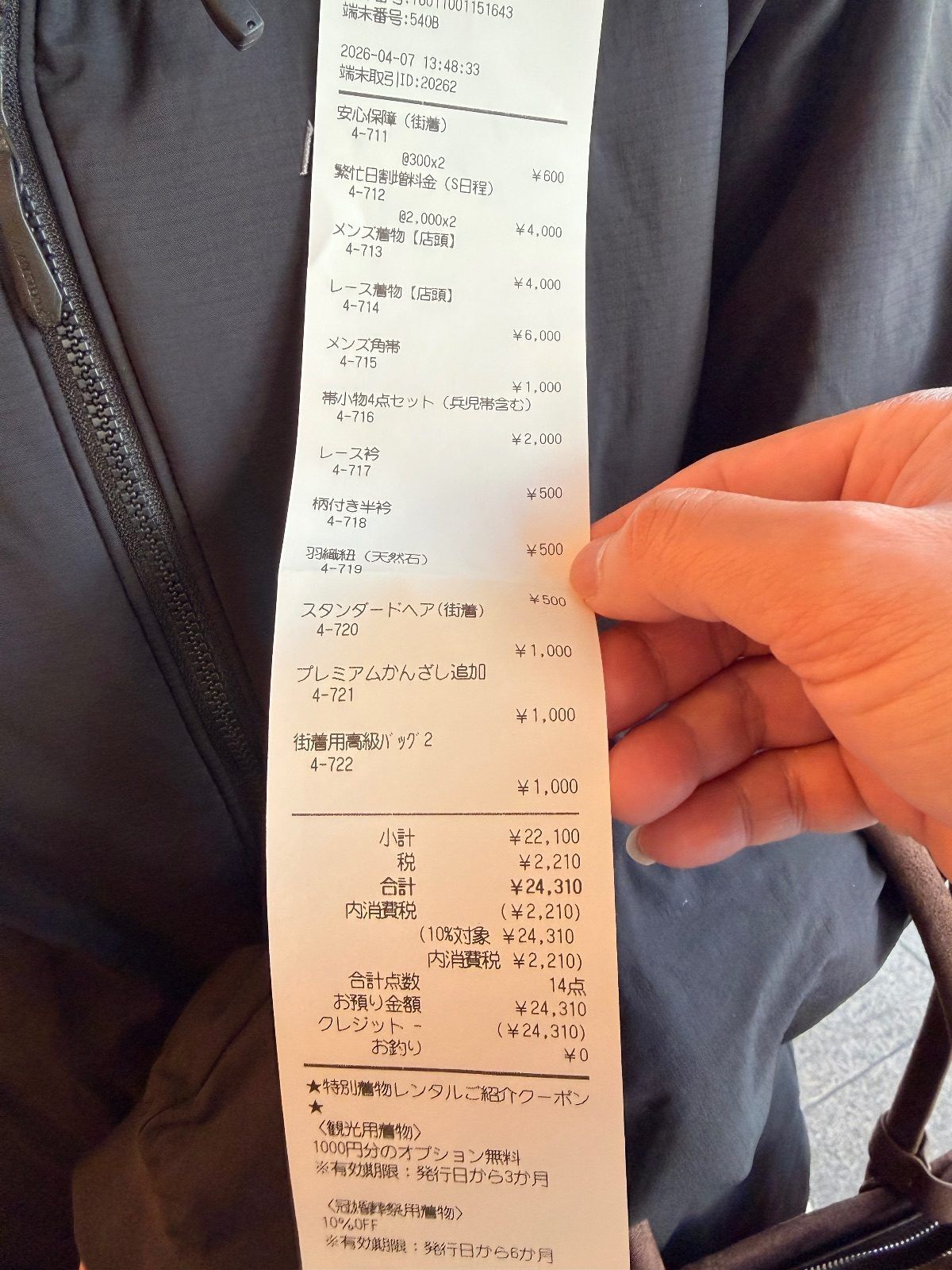
The kimono rental was ¥24,310 for two people, about $150, and the receipt lists 14 lines. The base rental is only part of it: an obi, a lace collar, hair styling, a premium hairpin and a bag are each priced separately, and in cherry blossom season there is a peak-day surcharge of ¥2,000 per person on top. If you are budgeting for a kimono day in early April, plan on roughly ¥10,000 to ¥12,000 per person once the extras and the seasonal rate are included, rather than the headline price on the sign.
3. The plastic bag fee is on 14 receipts
Japan charges for carrier bags, usually ¥1 to ¥7. It shows up on 14 of our receipts and adds up to ¥48 across the whole trip. Nobody is going to type that into an expense app, and nobody should have to. It is in the dataset only because a photo captures every line whether you care about it or not.
4. One bill, two tax rates
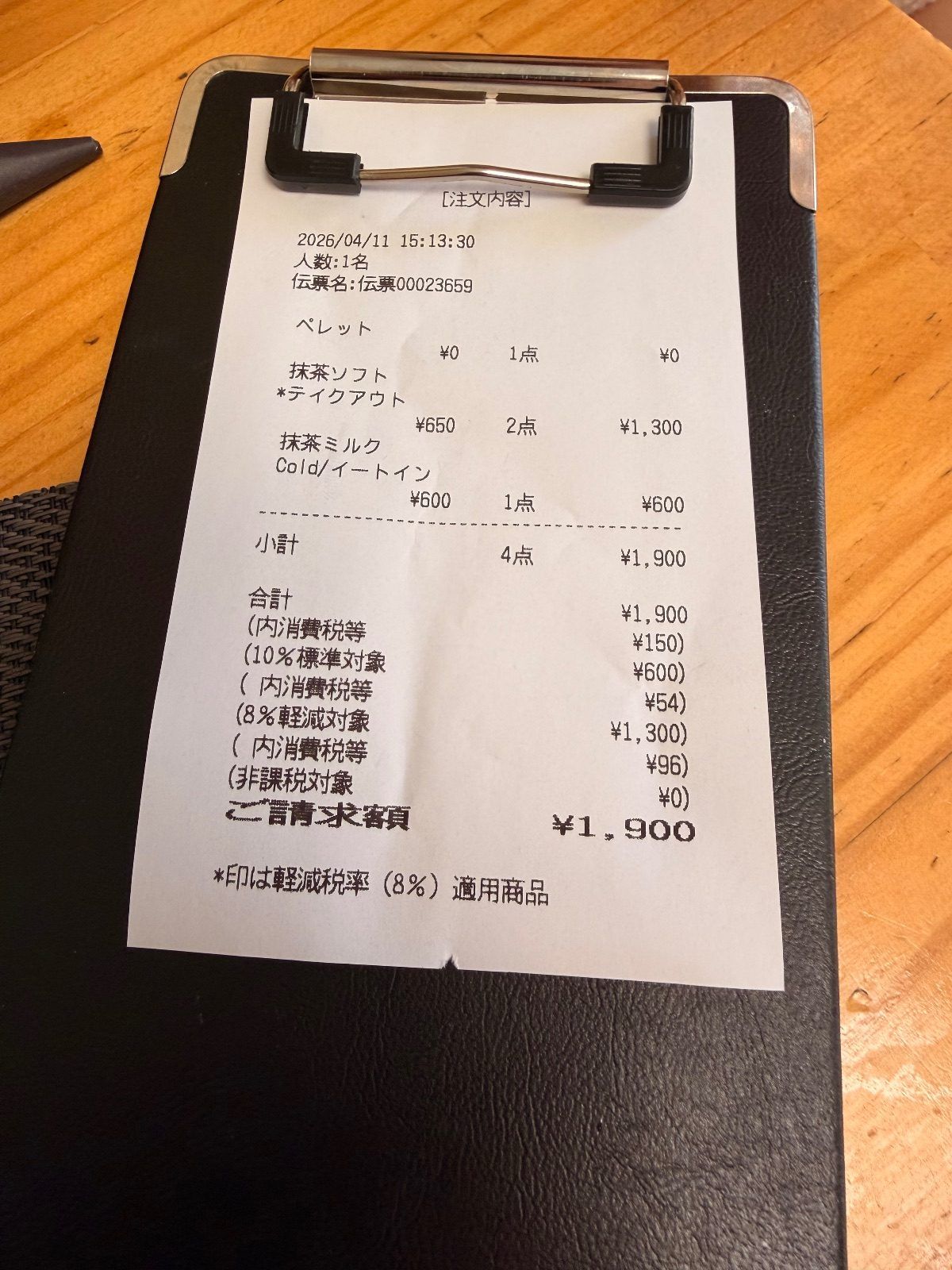
Japan applies 8% to food you take away and 10% to food you eat in. A matcha cafe in Tokyo charged us both on the same bill: 8% on the takeaway soft serve, 10% on the matcha milk we drank at the table. Two other receipts do the same thing. If you are splitting a bill by items, this is exactly the kind of detail that gets flattened when someone re-types a total from memory.
5. Card slips are useless for splitting
Five of our receipts are card slips rather than itemized bills: ¥17,942 of spend with nothing on the paper but a total. If you want to split by items later, photograph the itemized receipt, not the slip the terminal prints. This is the single most useful habit in the whole dataset, and the easiest one to get wrong when a waiter hands you both.
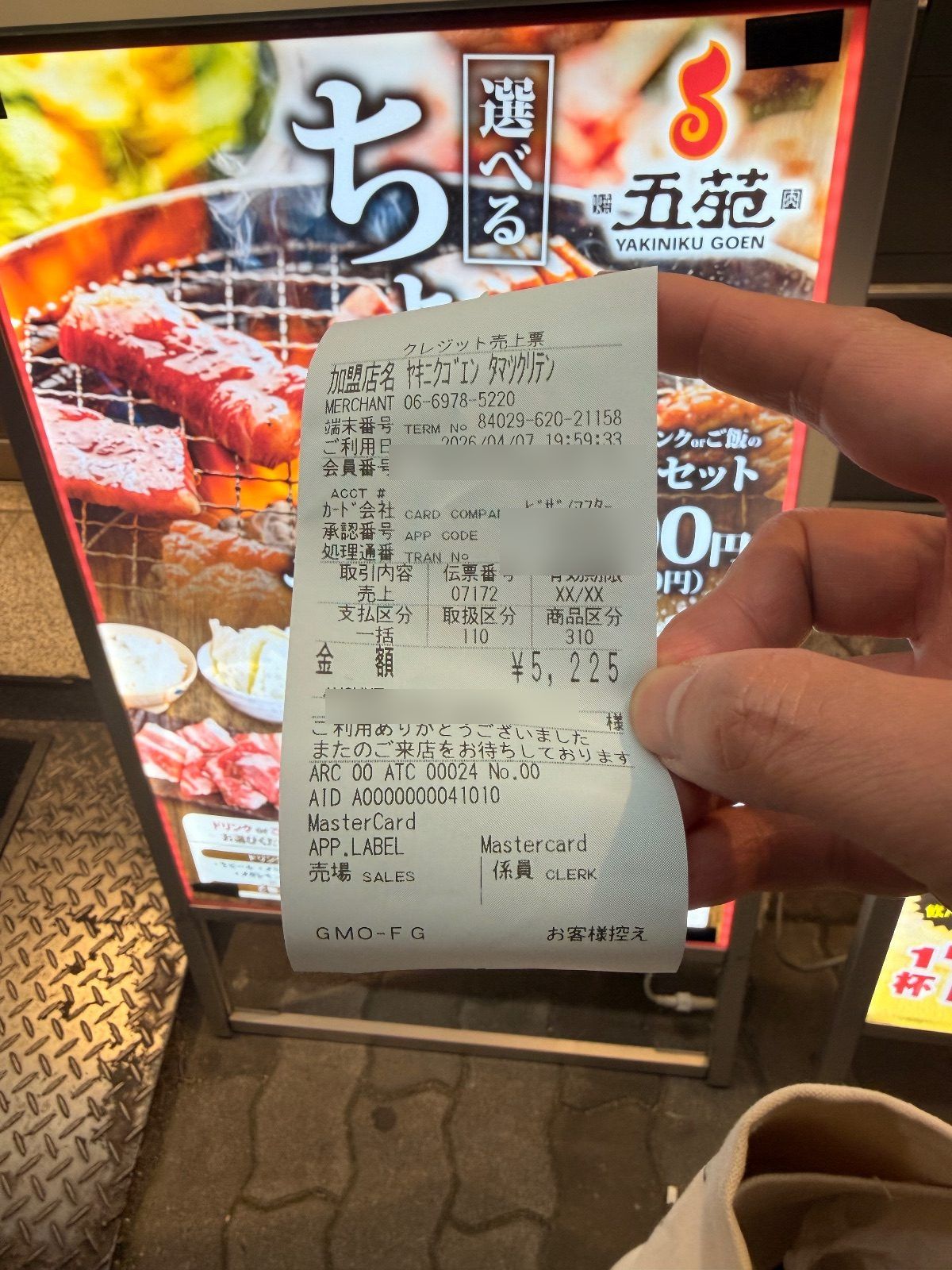
A card statement gives you a total. The receipt gives you the items, the tax and who ate what. That is why every receipt on this trip went straight into a shared trip chat in HippoSplit, where a photo becomes a logged, categorised, split expense in a few seconds; more on that below.
6. The biggest food receipt was not food we ate
The largest food-shaped receipt of the trip was not a meal, and none of it was eaten in Japan. It was ¥11,774 of Pocky, KitKat and matcha powder at a Don Quijote in Shibuya, 14 items in one go, bought to bring home for friends and family, with a second ¥5,775 run on the last day. The most expensive thing we actually sat down and ate was a ¥7,600 seafood lunch. Souvenir snacks are a gift budget wearing a supermarket receipt, and with the drugstore presents added, gifts were 12% of the whole trip, so they deserve a line of their own rather than being filed under food.
7. Otoshi: the small dish you did not order
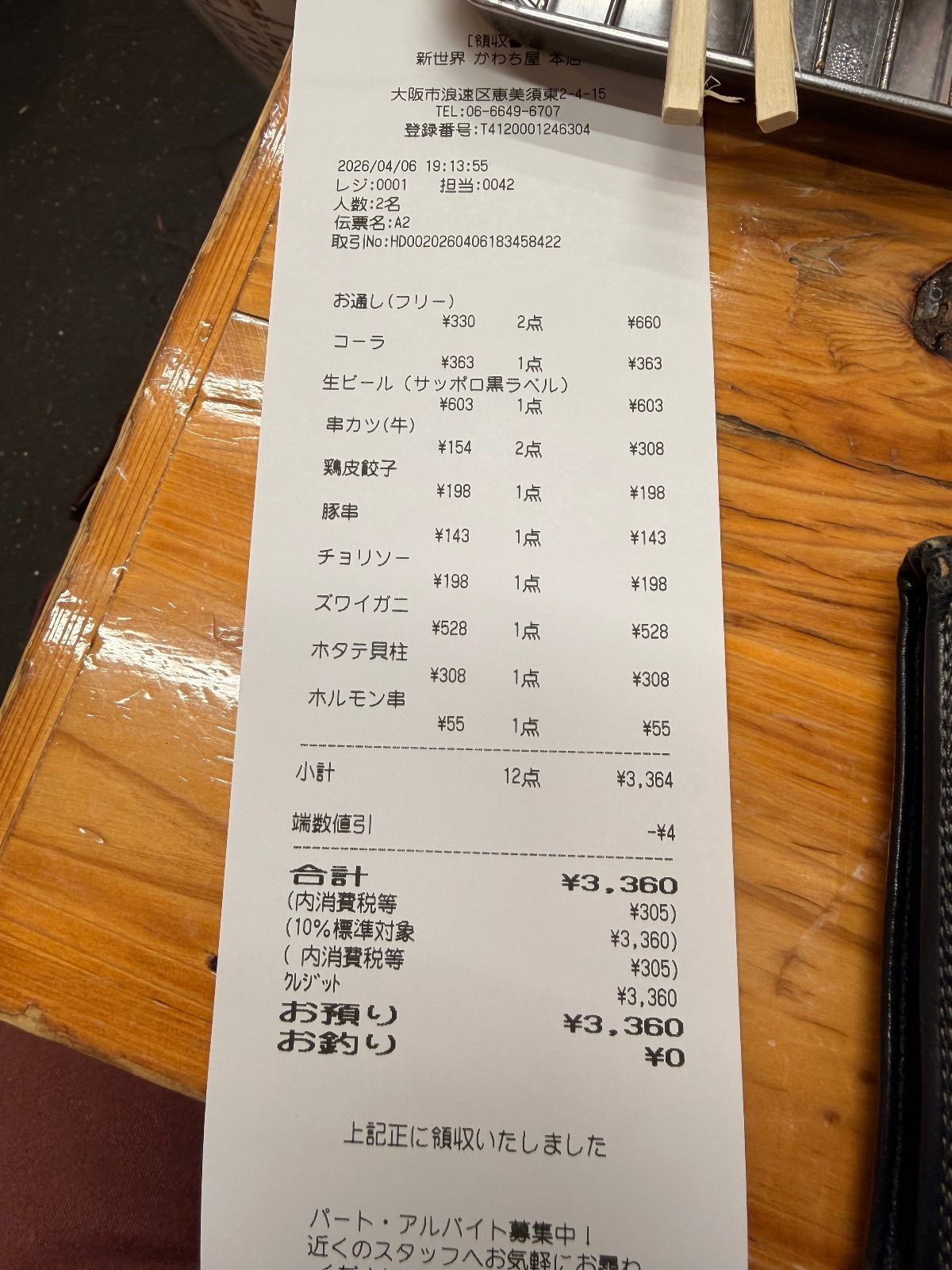
The kushikatsu bar in Shinsekai opened our bill with ¥330 per person for otoshi, the seating charge that arrives as a little dish nobody asked for. Japan does not tip, so this is roughly where the tip went instead, and ¥660 for two feels like a fair trade for a plate of something and a seat at the counter.
8. Where cash was actually needed
Cash is only 8% of our on-the-ground spending, and seven of the eight cash receipts fall on 13 and 14 April: food carts inside Disneyland, Tokyo Banana at the station, and ¥5,775 at Don Quijote Shinjuku spending down the last of the yen before the flight. That understates how useful it was, because the biggest cash use never produced a receipt we kept: the metro. We bought a Suica card with cash on arrival, topped it up with cash at the station machines a few times over the trip, and tapped it for every local train and bus after that. So the day-to-day transport ran on cash, just a few notes at a time, while restaurants, shops and the Shinkansen went on the card.
Planning a Japan travel budget: what this means for you
Budget accommodation first, because that is where a Japan trip is actually decided: ten nights was 42% of ours, and it is the one thing you commit to months ahead. Then budget around ¥10,950 per person per day for everything after you land, which for us covered FamilyMart breakfasts, one or two restaurant meals a day, local transport, a Shinkansen, a theme park and a lot of coffee. Budget gifts separately from food, because they do not behave like it: snacks, cosmetics and Japanese goods for people at home were 12% of our trip and not one of them was opened in Japan. If you are travelling as a group rather than a couple, the mechanics of who paid for what matter more than the total does, and that is a separate problem worth setting up before you go.
How we actually captured this
Every expense in this post was logged on the spot with HippoSplit, which I build. The habit is simple: when a receipt is handed over, photograph it and post it into the trip group, the way you would send a picture to friends. When there is no paper, screenshot the confirmation and post that instead. Two seconds, and you are back to the trip.
That is the whole job, because HippoSplit does the rest in a few seconds: it reads every line item, logs the total in the right currency, picks a category and splits it across the group. No form to fill in at the counter, no typing amounts into a spreadsheet at the hotel, no pile of receipts to decode when you get home. Add a caption like "Anna had the ramen, rest split even" and it splits by item too, or type "lunch 2400 split with Anna" when there is no receipt at all. Every table in this post, the categories, the day-by-day view, the per-person figures, is what the group showed us on day six, not something rebuilt in August. You can try it in a browser, and people you travel with can follow the tab from a link without signing up for anything.
If you want the raw numbers for your own planning, download the full dataset as a CSV: all 63 expenses with date, place, vendor, category, yen total and payment method. Use it freely; a link back to this post is appreciated.
Frequently asked questions
How much does a trip to Japan cost for two people?
This trip cost two people about ¥414,700 over 11 days, roughly ¥207,400 each, which was about $2,600 for the pair or $1,300 per person at April 2026 rates. Ten nights of accommodation was ¥173,800 of it, and ¥240,900 was spent after landing, about ¥10,950 ($69) per person per day for food, local transport, activities and gifts. Flights are excluded because their cost depends on where you fly from.
Is Japan expensive to travel in?
Day to day, less than most people expect. Our median receipt was ¥2,500 and nine were under ¥1,000, because convenience stores and casual restaurants are genuinely cheap. What makes Japan expensive is a small number of large purchases: long-distance trains, rentals and experiences. The daily rhythm is affordable, the set pieces are not.
How much does food cost in Japan per day?
We spent ¥72,354 on food and drink for two over 11 days, which is about ¥3,300 (roughly $21) per person per day. That mix was a FamilyMart breakfast most mornings, where a basket for two averaged ¥1,630, cafe stops, and one or two restaurant meals a day that ran from ¥1,800 at a Matsuya counter and ¥2,600 to ¥3,700 for two at a ramen shop up to ¥7,600 for a seafood lunch. Eat the same way and ¥3,000 to ¥4,000 a head per day is a realistic food budget; eat every meal in a restaurant and you will land nearer ¥6,000. All 33 food receipts are itemised in how much food costs in Japan, with ramen, konbini and restaurant prices line by line.
How much is the Shinkansen from Osaka to Tokyo?
We paid ¥28,791 for two reserved seats, about ¥14,400 per person. Our Mt Fuji round trip from Tokyo was another ¥11,000 each. Between them the two Shinkansen trips were nearly 80% of everything we spent on transport, so if your itinerary has long-distance trains in it, budget them as their own line rather than lumping them in with the metro.
Should you use cash or card in Japan?
Cards covered 83% of our on-the-ground spending, including convenience stores, chain restaurants, taxis and the Shinkansen. Cash still did real work, though. We loaded a Suica card with cash and topped it up with cash at station machines, which is how all of our metro and local train travel was paid. And plenty of small shops across Japan are still cash only: street food stalls, market stands, small family-run restaurants and bars, temple and shrine counters, and several food carts inside Tokyo Disneyland. Card first, but keep ¥10,000 or so in your pocket for Suica top-ups and the cash-only counters you will meet every day.
What is otoshi on a Japanese restaurant bill?
Otoshi is a seating charge of a few hundred yen per person that comes with a small dish you did not order. Ours was ¥330 each at an Osaka kushikatsu bar. It is standard at izakaya-style places and it is not a tip, though since Japan does not tip it lands in much the same spot on the bill. Think of it as a cover charge with a snack attached.
Why do some Japanese receipts show 8% and 10% tax?
Japan uses a reduced 8% rate for food and drink you take away and the standard 10% rate for eating in, plus most non-food items. One order can carry both, which is why a single cafe bill in this dataset splits its total across two tax lines. Receipts usually mark the reduced-rate items with a symbol and print the two subtotals separately.
How do you split a trip like this with other people?
Log each expense as it happens with whoever paid attached to it, then settle once at the end rather than paying each other back all trip. The arithmetic of working out who owes who after a group trip is straightforward once every expense has a payer; it is only painful when you are reconstructing it from memory and a camera roll two weeks later.
How much should you budget for accommodation in Japan?
We paid about ¥173,800 for ten nights in Airbnb units for two, four nights in Osaka and six in Tokyo, booked one to two months ahead. That is roughly ¥17,400 a night for the pair of us, or ¥8,700 each, and Tokyo was the more expensive of the two. It made up 42% of the whole trip, more than food and gifts combined, which is the usual shape of a Japan trip: the room is the budget, and everything else is smaller than it feels while you are spending it.