How much does a trip to Thailand cost in 2026? A real per-person budget
What 10 nights across Bangkok, Chiang Mai and the islands really costs per person in 2026: hotels, street food, flights, boats, entry fees, the ATM fee nobody mentions, and how a group splits it.
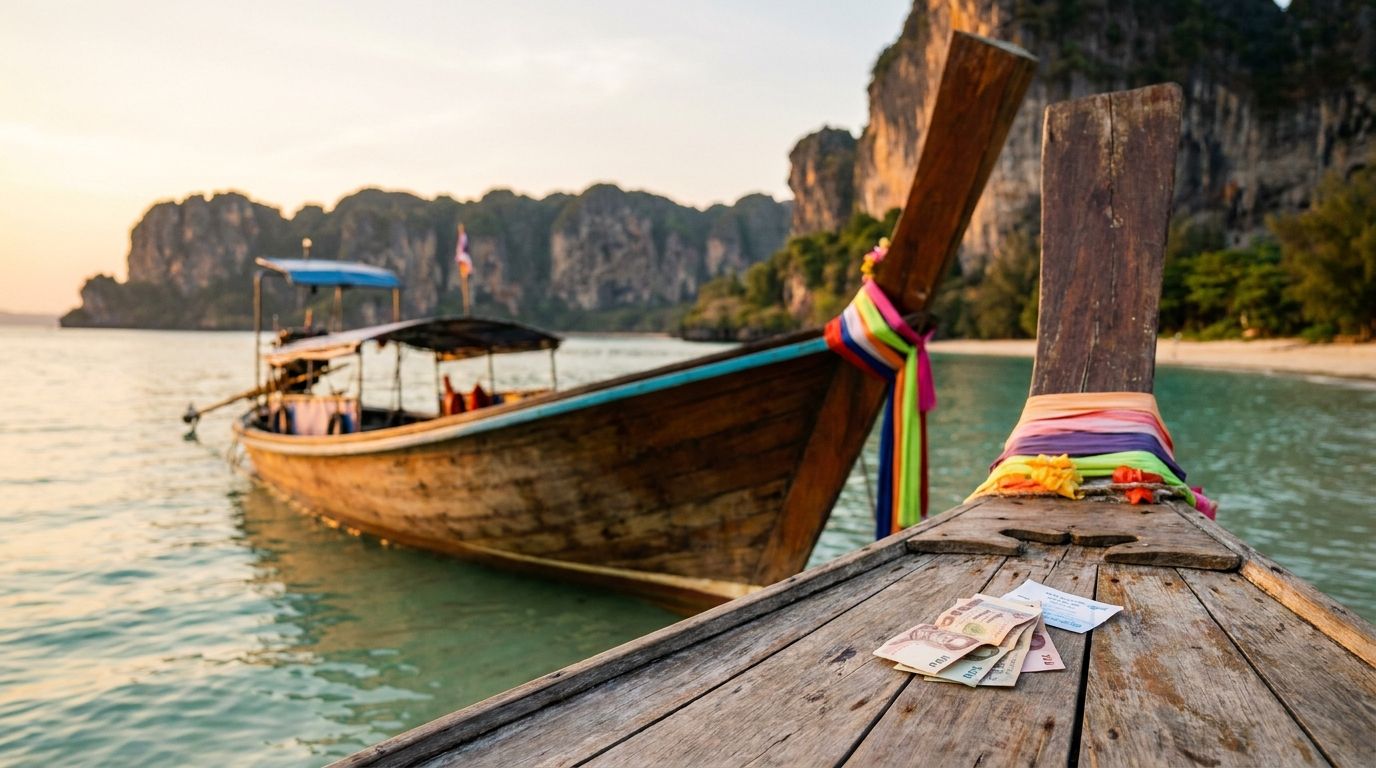
Thailand has a reputation as the cheapest great trip you can take, and for the day-to-day it still is. A plate of pad thai from a street stall costs less than two dollars, a clean guesthouse room is under twenty, and a temple that would be a paid museum anywhere else is often free.
The bill still surprises people, because the cheap part is not where the money goes. Long-haul flights, peak-season island hotels, two or three domestic flights, boat transfers and a steady stream of foreigner-priced entry fees are what set the total. This post gives a per-person budget for a 10-night trip in three tiers, the costs people forget to plan for, and how a group keeps hundreds of tiny baht purchases straight.
How much does a trip to Thailand cost? The short answer
For 10 nights covering Bangkok, Chiang Mai and the islands, budget roughly 18,700 baht per person (about $565) on hostels, street food and budget airlines, about 39,500 baht (about $1,200) for a comfortable mid-range trip with private rooms and a few tours, and around 94,000 baht (about $2,850) at the premium end. International flights are on top, and from the US they usually add $900 to $1,500 per person in high season.
That works out to about $57, $120 and $285 per person per day, all in except the flight to get there. Prices below use about 33 baht to the dollar, the rate in mid September 2026, and were checked in September 2026 for the November to February peak season. Off-peak, knock 15 to 30 percent off the accommodation and domestic flight lines and leave everything else alone.
The example is a group of four, 10 nights, four in Bangkok, three in Chiang Mai and three on the Andaman coast around Krabi and Phi Phi, traveling in December or January:
| Per person, 10 nights | Budget | Balanced | Premium |
|---|---|---|---|
| Accommodation | 5,500 THB (~$165) | 13,000 THB (~$395) | 33,000 THB (~$1,000) |
| Food and drink | 3,500 THB (~$105) | 8,000 THB (~$240) | 20,000 THB (~$605) |
| Domestic flights, two legs | 4,000 THB (~$120) | 5,500 THB (~$165) | 10,000 THB (~$305) |
| Boats and airport transfers | 1,500 THB (~$45) | 2,500 THB (~$75) | 6,000 THB (~$180) |
| City transport | 1,200 THB (~$35) | 2,500 THB (~$75) | 6,000 THB (~$180) |
| Temples, parks, tours | 2,000 THB (~$60) | 6,000 THB (~$180) | 15,000 THB (~$455) |
| SIM, tips, laundry, small stuff | 1,000 THB (~$30) | 2,000 THB (~$60) | 4,000 THB (~$120) |
| Total per person, excluding international flights | about 18,700 THB (~$565) | about 39,500 THB (~$1,200) | about 94,000 THB (~$2,850) |
For reference, the daily ranges travel sites publish for 2026 sit at roughly 900 to 1,800 baht a day for backpackers, 2,200 to 3,600 for mid-range and 8,000 plus for luxury, before any flights, tours or transfers. Our tiers land at or just above the top of those bands once you spread the transport and activity costs across the trip, which is the part most daily budgets leave out.
The full cost breakdown
Accommodation
This is the line with the widest spread and the one peak season moves most. A hostel dorm bed starts around 400 baht on the mainland and 600 to 900 on the islands in December, and a private fan-cooled or air-conditioned guesthouse room is 400 to 700 baht in Chiang Mai and the north. Comfortable three-star hotels run about 1,200 to 2,500 baht a night for the room, so 600 to 1,250 per person when two people share, which is where the balanced figure comes from.
The islands are the exception. In December and January a decent beachfront room on Phi Phi, Koh Lanta or Railay is often double the mainland price for the same standard, beachfront rates rise 40 to 70 percent over green season, and the last two weeks of December sell out months ahead. The balanced tier assumes three island nights at about 2,000 baht per person and seven mainland nights near 1,000.
At the premium end, a four-star resort with a pool is 4,000 to 8,000 baht a night for the room, and five-star beach resorts start above 10,000. The 33,000 baht premium figure is a mix of a good Bangkok hotel, a boutique place in Chiang Mai and a resort on the coast, not five-star throughout.
Food and drink
Street food is the reason Thailand is cheap. Pad thai, boat noodles or a rice dish from a stall is 40 to 80 baht, a fruit shake is 30 to 50, and a full street dinner for four rarely passes 400 baht. A sit-down meal in a mid-range restaurant is 150 to 350 baht a head, and a large local beer in a bar is 80 to 150 baht, more on the islands.
The budget tier eats from stalls and markets at about 350 baht a day. The balanced tier mixes street food with restaurant dinners and drinks at about 800 a day. The premium tier, at 2,000 a day, covers rooftop bars, hotel breakfasts and a couple of tasting-menu nights in Bangkok, which is now a serious food city with prices to match.
Getting around the country
Domestic flights are cheap off-peak and merely reasonable in December. Bangkok to Chiang Mai or Bangkok to Phuket on AirAsia, Nok Air or Thai VietJet is 900 to 1,500 baht one way when booked a few weeks out, but in peak season expect 1,500 to 2,500. Chiang Mai to Krabi is the expensive leg: AirAsia is the only airline flying it direct, fares start around 2,200 baht and typically run 2,500 to 4,500 in December. Two legs at the budget tier come to about 4,000 baht. The balanced tier adds a checked bag on each leg, and the premium tier flies Thai Airways or Bangkok Airways, usually via Bangkok, at two to three times the fare.
The overnight train from Bangkok to Chiang Mai is the classic alternative at roughly 900 to 1,500 baht for a second-class sleeper berth, and it saves a night of accommodation. Slower, but it is the trip a lot of people remember most.
Boats and transfers
Island travel is a chain of small tickets. The Phuket or Krabi ferry to Phi Phi is about 450 to 700 baht each way, a Krabi longtail to Railay is 100 to 200, and airport transfers on the coast are 150 baht by shared minibus or 600 to 1,000 by taxi. Add the 400 baht national park fee for the Phi Phi marine park, charged in cash on arrival, and the boats line is easily 1,500 baht per person even on a budget.
City transport
Bangkok's BTS Skytrain and MRT cost 17 to 62 baht a ride and beat traffic every time. Grab, the local ride-hailing app, runs 60 to 250 baht for most city hops and quotes the price up front, which removes the meter argument entirely. In Chiang Mai the red songthaew pickups are 30 to 40 baht a ride and tuk-tuks are whatever you negotiate, usually 100 to 200.
Renting a scooter on the islands is 250 to 400 baht a day plus fuel, and it needs a motorcycle license to be insured, which most travel policies check after an accident, not before.
Temples, parks and tours
The three big Bangkok temples cost 1,000 baht together for foreigners: the Grand Palace 500, Wat Pho 300, Wat Arun 200. Most other temples are free or 50 to 100 baht. National parks charge foreigners 200 to 400 baht each. Tours are where the balanced and premium tiers diverge: a Chiang Mai cooking class is about 1,000 to 1,500 baht, a half day at an ethical elephant sanctuary 2,000 to 3,000, a Phi Phi snorkeling boat 1,200 to 2,500, and a Bangkok food tour about 1,500 to 2,500.
Everything else
A tourist SIM or eSIM with plenty of data is 300 to 600 baht for the trip. Laundry by the kilo is 40 to 60 baht. A Thai massage is 300 to 500 baht an hour and most people have more than one. Tipping is not expected but 20 to 50 baht at restaurants and for drivers is common, and it adds up across 10 days.
What nobody budgets for on a Thailand trip
Foreigner pricing. Thailand charges non-residents more at temples, national parks and some attractions, often five to ten times the Thai price. It is legal, it is posted, and it is why the activities line is bigger than the guidebook suggests. Budget the foreigner price and treat any exception as a bonus.
The 250 baht ATM fee. Almost every Thai bank ATM now charges foreign cards 250 baht per withdrawal, and several charge 350 for foreign Mastercards, on top of whatever your own bank charges. AEON ATMs, found in malls and Big C stores, charge 150. Four people each pulling out small amounts every couple of days can spend 3,000 baht on fees alone. Withdraw the daily maximum less often, decline the ATM's offer to convert to your home currency, and use a card with no foreign transaction fee for hotels and flights.
Cash-only everything, unless you can scan. Street food, songthaews, longtails, market stalls, the national park fee and many island guesthouses do not take cards. Someone in the group ends up paying for everyone at the pier and being owed by three people at once.
Locals barely carry cash anymore. Almost every stall, taxi and guesthouse has a PromptPay QR code taped to the counter, and Thais pay by scanning it with their banking app. Foreigners can join in: the Wise app now scans Thai QR codes and pays from your Wise balance, the TAGTHAi app has an Easy Pay feature for tourists that you top up at Kasikornbank exchange booths in airports and malls, and visitors from Singapore, Malaysia, Indonesia and India can scan Thai QR codes straight from their home banking app. Set one of these up before you fly and the cash pile shrinks, though the park fee and some boats still want notes.
The visa change. Thailand's 60-day visa exemption ended on 15 September 2026. Most nationalities, including US, UK, Canadian and Australian passport holders, now get 30 days on arrival with an optional one-time 30-day extension of about 1,900 baht at immigration. A 10-night trip is unaffected. Anyone planning a month-plus trip needs the extension or a tourist visa. The free Thailand Digital Arrival Card is also mandatory, filed online within 72 hours before you land, and it costs nothing on the official site. Sites that charge for it are not the government.
Peak-season surcharges. Island hotels and resorts often add a compulsory gala dinner on 24 and 31 December, typically 2,000 to 5,000 baht per person, and it appears in the booking small print rather than in the room rate.
Budget airline extras. Domestic fares are cheap because the baggage is not. A 20 kilogram checked bag added at booking is 400 to 700 baht per leg. Added at the airport, it is two to three times that.
The 7-Eleven effect. Water, sunscreen, mosquito spray, snacks and a beer on the way to the beach are each under 100 baht and nobody records them. Across 10 days and four people it is thousands of baht that never appears in anyone's plan.
How the three tiers actually feel
| Budget | Balanced | Premium | |
|---|---|---|---|
| Sleep | Hostel dorms and fan guesthouses, mainland heavy | Three-star twin-share hotels, a beach bungalow on the islands | Boutique hotels and a pool resort on the coast |
| Eat | Street stalls and night markets, 7-Eleven breakfast | Street food by day, restaurant dinners with drinks | Hotel breakfasts, rooftop bars, a tasting menu in Bangkok |
| Move | Budget airline no bags, overnight train, songthaews | Budget airline with bags, Grab, shared minibuses | Full-service flights, private transfers, speedboats |
| Do | Free temples, beaches, one snorkel trip | The big three temples, a cooking class, an elephant sanctuary, one boat day | Private guides, longtail charters, spa days |
| Per person | about 18,700 THB (~$565) | about 39,500 THB (~$1,200) | about 94,000 THB (~$2,850) |
Splitting a Thailand trip, where the money is big early and tiny later
A Thailand trip has two completely different money shapes stapled together. Months before departure, one or two people put the hotels and the domestic flights on their card, which for a group of four at the balanced tier is well over 70,000 baht of prepayment sitting on one person. Then, on the ground, the trip turns into hundreds of purchases under 200 baht, most of them cash, paid by whoever had change.
That combination is what breaks the usual "we'll sort it out at the end" plan. The big prepayments are remembered but the person who paid them quietly subsidizes everyone for two months. The small stuff is forgotten within a day, and the one who kept paying for the pier fees, the water and the songthaews never gets it back.
Four rules make it work. Log every prepayment on the day it is paid, in the currency it was paid in. Treat a round of street food or a shared taxi as a group expense recorded on the spot, not a favor. Agree up front that massages, shopping and scooter rentals are personal unless the whole group does them. And keep one person's cash withdrawals out of the split entirely; the withdrawal is not an expense, the things it buys are.
Then settle once, at the end, in one pass. If you want the mechanics of that, who owes who after a group trip walks through the math, and the general playbook is in how to split trip expenses with friends.
How groups keep it straight in baht and dollars
Thailand is the trip HippoSplit fits best, because the volume of small expenses is exactly what a chat can absorb and a spreadsheet cannot.
Type "pad thai and shakes 320 split with Anna, Ben and Kim" into the group chat while you are still at the stall and it is logged and split. Or post a photo of the receipt straight into the chat, the same way you would send a picture to friends, and HippoSplit reads it and files the expense with its items, total and currency. On the days that are all cash and no receipts, a two-second message keeps the record alive.
The dollar hotel booking from October and the baht ferry ticket in January live in the same group. HippoSplit handles 150 plus currencies at live rates and converts as it goes, so nobody has to agree on a rate at the end and nobody does mental math at a pier.
For an expense that is not split evenly, caption the photo with what happened, for example "Ben's massage his own, dinner shared four ways", and the split follows the caption. The friend who refuses to install anything can open the group from a link and follow the running total as a guest without signing up; they see everything, and adding expenses needs a free account. If you are budgeting before you book, the free travel budget template has a per-person tab built for exactly this kind of trip.
Thailand trip cost FAQ
How much does a two-week trip to Thailand cost?
Scale the 10-night figures up by about 40 percent: roughly 26,000 baht (~$790) budget, 55,000 baht (~$1,670) balanced and 130,000 baht (~$3,950) premium per person, before international flights. The extra nights are usually cheaper than the first ten because you fly less and stay longer in each place.
Is Thailand expensive in 2026?
Day to day, no. Street food, local transport and guesthouses remain among the cheapest in Asia. What has risen is the cost of getting there, the peak-season price of island hotels and domestic flights, and bank fees on foreign cards. A mid-range trip is still about $120 a day all in.
Do I need a visa for Thailand?
For stays under 30 days, most US, UK, EU and Australian passport holders do not. Since 15 September 2026, 30 days is the standard visa-free period, replacing the 60-day scheme, with a one-time 30-day extension available at immigration. Longer trips need that extension or a tourist visa. Everyone must file the free Thailand Digital Arrival Card online within 72 hours before arrival. Rules change, so check the Thai immigration site before you fly.
How much cash should I carry in Thailand?
Plan on 1,000 to 2,000 baht per person per day in cash for street food, transport, markets and small entry fees, and put hotels, flights and tours on a card. Withdraw larger amounts less often to limit the 250 to 350 baht ATM fee, or use an AEON machine, and carry exact change for boats and park fees.
When is the cheapest time to visit Thailand?
May to October, the green season, when hotel rates on the islands drop 20 to 40 percent and flights are cheaper. Expect afternoon rain rather than washed-out days. November to February is the dry peak and the most expensive, with the two weeks around Christmas and New Year at the very top.
What does a Thailand trip cost for a group of four?
At the balanced tier, about 39,500 baht each, so roughly 158,000 baht (about $4,800) for four people over 10 nights before international flights. Sharing rooms, booking domestic flights early and eating at stalls for most lunches are the three changes that move the number most.
Is 1,000 baht a day enough in Thailand?
For a backpacker on the mainland, yes: a dorm bed, three street meals, local transport and a temple or two fit inside 1,000 baht. It does not cover domestic flights, boats, tours or the islands in peak season, which is why the budget tier in this guide comes to about 1,900 baht a day once those are spread across the trip.
The bottom line
Thailand is cheap per meal and mid-priced per trip, and the gap between those two facts is what surprises people. The street food is not where the money goes. Long-haul flights, peak-season island rooms, a chain of domestic flights and boats, and foreigner-priced entry fees are.
Book the island nights and the domestic flights early, go outside the Christmas fortnight if you can, eat from the stalls, and log the small stuff as it happens. For a real trip broken down receipt by receipt, 11 days in Japan in 61 receipts shows what that record looks like at the end.
Planning one for this winter? Start a HippoSplit group, drop the hotel booking in on the day you pay it, and let the baht and dollars take care of themselves.