The 30-day receipt challenge: photograph every receipt for a month
One rule for one month: photograph every receipt at the counter. No budget, no spreadsheet. What people learn in each of the four weeks, and how to run it with the people you share money with.
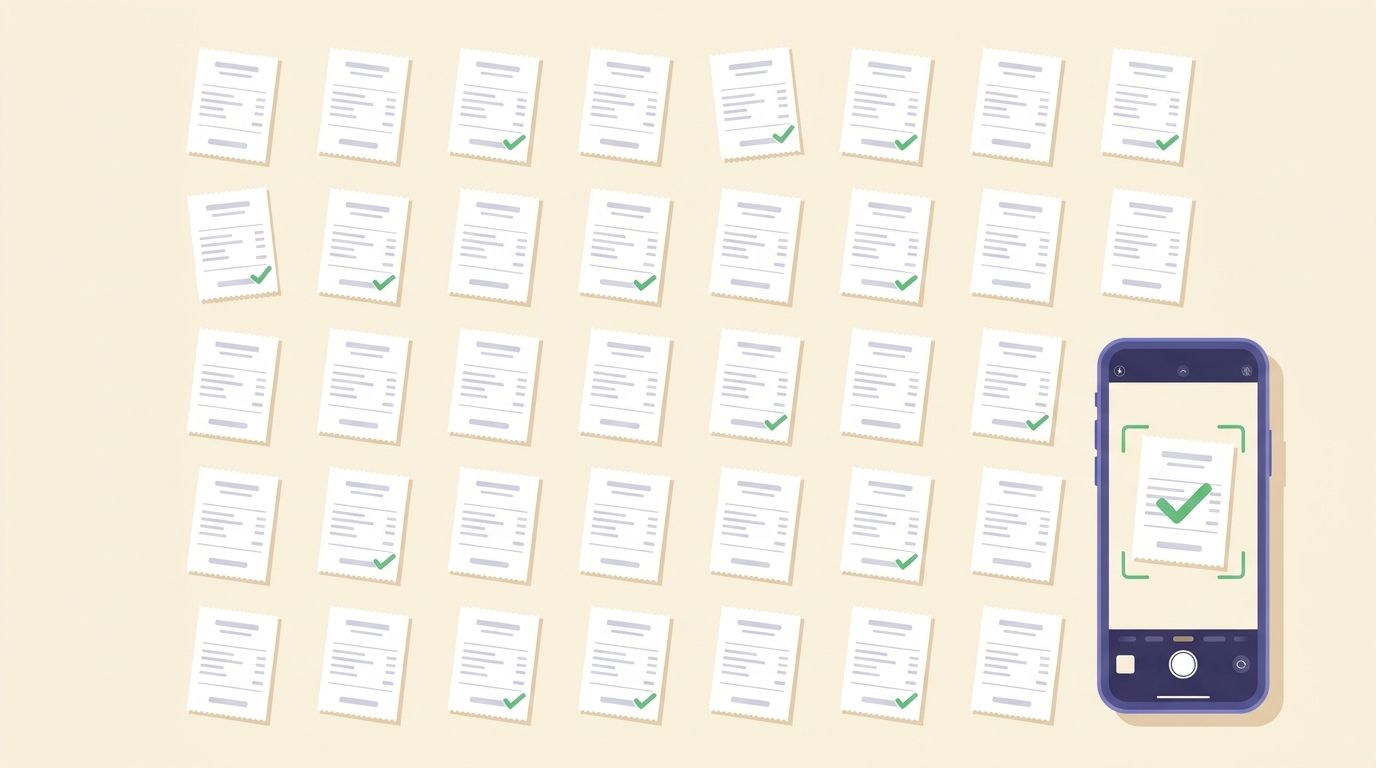
The 30-day receipt challenge has one rule: for one month, photograph every receipt you get, at the moment you get it, and do nothing else. No budget, no categories to fill in, no spreadsheet at the end of the week. Just the photo.
It sits in the same family as the no-spend month and the 100 envelope challenge, but it asks less of you and, in our experience, teaches more. This post explains the rules, what people tend to learn in each of the four weeks, how to run it as a couple, a household or a travel group, and how to do it in a group chat so the record adds itself up.
The challenge in one paragraph
For 30 days, take a photo of every receipt at the point of purchase: the coffee, the groceries, the gas, the online order confirmation, the split dinner. If there is no receipt, type a one-line note instead, "parking 4.50". Post each one into a single place, ideally a chat you already look at, so the habit costs about three seconds and needs no app-opening ritual. Do not categorize, do not total, do not judge; the only job is capture. At the end of each week, spend ten minutes reading the month so far. By day 30 you have a complete, timestamped record of a month of spending, built without a single evening at a spreadsheet, and that record is what does the teaching. Most people find the second half of the month looks different from the first, without ever setting a rule about it.
Why a photo and not a spreadsheet
Expense tracking usually fails by the third week, and it fails for one reason: the entry happens later than the purchase. By the evening the receipt is in a pocket, the amount is a guess and the whole thing feels like homework. The photo moves the entry to the moment the money leaves, which is the only moment you reliably remember it.
A photo also keeps the detail a spreadsheet throws away. A row that says "groceries 84.20" tells you nothing a month later. The receipt tells you that 31 of it was snacks, that you bought the same thing twice in a week, and that the store's loyalty discount did not apply. That is where the learning is, and it is why we keep pushing the receipt habit over the budget habit. If you are curious how the app reads a receipt, see how AI receipt scanning works.
The rules
| Rule | What it means in practice |
|---|---|
| Every receipt, no exceptions | The 1.50 vending machine counts. Small purchases are the point, because they are the ones you cannot recall. |
| At the moment of purchase | Photograph it before you leave the counter. If you walk away with it in your pocket, the odds it gets logged drop fast. |
| No receipt, one line of text | "bus 2.75", "tip 5 cash", "street food 12". Ten seconds, same place as the photos. |
| One place only | A chat, an album, a folder. Never two. Splitting the record across places is the same as not keeping one. |
| No categorizing during the month | Sorting is what makes tracking feel like work. If your tool categorizes automatically, fine; if not, leave it. |
| Ten minutes every Sunday | Read the week back. That is the only review. Do not make a chart. |
| Zero rules about spending | This is not a no-spend month. Changing what you buy is a side effect, not the assignment. |
What tends to happen, week by week
The pattern below comes from running the challenge ourselves and from the receipt archives behind our travel posts, including 11 days in Japan in 61 receipts. Yours will differ in the details and probably not in the shape.
Week 1: you find out how many purchases you make
Most people guess they buy something two or three times a day. The first week's count is usually higher, because the small ones, the coffee, the parking, the app top-up, were never being counted. Nothing to fix yet. Just notice that the number of transactions is the surprise, not the amounts.
Week 2: the repeats show up
By the second Sunday, the same three or four merchants are on the list many times over. This is where "I don't really spend much on X" meets the receipts. The other thing that appears is the unplanned small purchase attached to a planned one: the snack with the fuel, the extra item at the checkout, the delivery fee on the order.
Week 3: the photo starts changing the purchase
Around day 15 to 20, the act of knowing you will photograph the receipt begins to sit between you and the register. Nobody decides to spend less, but a share of the impulse purchases quietly stops, because the three-second logging step is just enough friction to ask "do I want this". This is the week the challenge earns its keep, and it happens without a budget.
Week 4: you have a month you can search
The last week is mostly about the record itself. You can answer questions you never could before: what did the week before payday look like, how much of the food spend was eating out, what did that trip actually cost. If a return, a warranty claim or a reimbursement comes up, the receipt is there. That searchable month is the thing most people keep after the 30 days, even if they stop logging everything.
Running it with other people
The solo version works, but the challenge is better shared, because the habit is easier to keep when someone else can see the feed.
Couples: one shared chat, both of you post, and the Sunday review becomes a ten-minute money check-in that replaces the awkward monthly conversation. Nothing gets split unless you want it to; the point is a single record of the household month.
Roommates: photograph the shared purchases only, groceries, cleaning stuff, the utility bill. It doubles as the fairest version of "who has been buying the toilet paper", and at the end of the month there is a record instead of a memory. If bills are part of it, recurring bills with roommates covers the setup.
Travel groups: this is the challenge's natural home. A trip is a compressed month of spending, hundreds of small purchases in someone else's currency, and the receipts are the only version of events everyone agrees on. Run the challenge for the length of the trip and settle up once at the end.
Families: one parent or both post, and older kids can too. A month of receipts is a very plain way to show where the money goes without a lecture.
How to run the challenge in HippoSplit
We built HippoSplit around exactly this habit, which is why it is the easiest place to run the challenge. Make a group, either just for you or with the people you share money with, and treat it as the one place.
Post a photo of the receipt straight into the group chat, the same way you would send a picture to a friend. HippoSplit reads it and logs the expense with its items, total, currency and a category, so the "no categorizing" rule takes care of itself. For a purchase with no receipt, type it into the chat, "coffee 4.20" or "lunch 24.50 split with Anna and Ben", and it is logged the same way. The step-by-step is in how to scan receipts with AI.
The Sunday review is the group's expense list and balances. On a shared group, who owes who is kept current as you post, and the month ends with one settle-up rather than a reconstruction. Everything is editable, so if the reading gets a line wrong you fix it in place, and the totals are calculated by HippoSplit, not by the AI, so the numbers you review are the real ones.
One honest note on limits. The free plan includes 20 AI scans a week, which covers most people's receipts. If your month runs hotter than that, type the small ones and photograph the long ones, or the group creator can go Premium for unlimited scans, which covers everyone in the group. Photos are visible only to the group, encrypted at rest and never used to train the AI.
When to run it
Any month works, but two dates line up with a reset. January, because a month of receipts beats a budget resolution that nobody keeps past February. September, because the summer travel is over, routines restart, and roommates and students are settling into a new place with new shared costs. The challenge is short enough to repeat, and the second run is where the comparison gets interesting.
30-day receipt challenge FAQ
Do I really have to photograph every receipt?
Yes, for the month. The small purchases are the ones memory drops, and they are usually where the pattern is. If a receipt does not exist, a one-line note is the substitute; skipping is the only thing that breaks the challenge.
What if I miss a day?
Log what you can remember that evening and carry on. One patchy day does not matter; a week of them does. The habit is the outcome, not a perfect ledger.
Should I set a budget for the month?
No. Run the challenge without one, then set a budget afterward using the record if you still want to. A budget set before you know where the money goes is a guess, and the challenge exists to replace the guess.
Can I do the challenge with a spreadsheet instead?
You can, and our free expense tracker template is built for it. The trade is friction: a spreadsheet entry happens later than the purchase, and later is where tracking dies. If you use one, keep the photo step anyway and enter the amounts on Sunday.
What do I do with the receipts at the end?
Keep the record and stop worrying about the paper. A searchable month is useful for returns, warranties, reimbursements and the next time someone asks "what did that trip cost". If you ran it as a group, settle up once and start the next month clean.
Is this the same as a no-spend challenge?
No. A no-spend month restricts what you buy. The receipt challenge changes nothing about spending and only asks you to record it. Most people spend less anyway by week three, but that is a side effect, and it lasts longer because nothing was banned.
Start on the first of the month, or today
Pick a day, make the one place, and photograph the first receipt. Thirty days later you will know exactly what a month costs, and you will have done it in three seconds at a time. Start a HippoSplit group and post the first receipt into it, or run it in whatever chat you already keep open. The rule is the same either way: every receipt, at the counter, one place.